
When a private equity-backed industrial services platform approached Nova Capital Consulting, its growth-by-acquisition strategy had outrun its process. The company had closed four bolt-on deals in three years, but each one was diligenced from a blank page, tracked across disconnected spreadsheets, and closed under pressure rather than on a plan.
When a $46 million target entered a competitive, 90-day exclusivity window, leadership needed more than deal advice, they needed a readiness system built before the next signature, not during it.
The client, a mid-market industrial services platform generating roughly $210 million in revenue, had built its growth story on acquisitions. But its deal function had no standing infrastructure: no shared data room templates, no standardized financial or legal request lists, and no formal criteria for deciding which targets were worth pursuing. Each transaction was staffed ad hoc, with deal leads improvising a diligence approach under whatever timeline the seller’s banker imposed.

Without a repeatable framework, every new opportunity restarted the clock on process design instead of analysis. Financial, legal, commercial, and operational workstreams ran sequentially rather than in parallel, and nobody owned the handoff between diligence findings and integration planning. This pattern mirrors what much of the market experiences: Harvard Business Review has documented that a majority of acquisitions fail to deliver their expected value, and the root cause is rarely deal selection, it’s execution discipline that breaks down between signing and close.
The client didn't have an M&A problem, they had a readiness problem. Every deal was reinventing the wheel under time pressure, and that's exactly the moment costly issues get missed instead of caught.
M&A Advisory & Deal Readiness

The consequences were already visible. On the prior acquisition, a working capital shortfall surfaced only after close, eroding deal value the model had assumed was secure. The board had grown wary of the pipeline’s pace, not because targets were poor, but because the firm couldn’t demonstrate it could execute consistently under time pressure without new surprises.
The new opportunity, a $46 million regional competitor with two other active bidders, gave the client a 90-day exclusivity window and no room for a repeat of the prior deal’s post-close surprises. Leadership needed a process that could move at competitive speed while catching what the last diligence effort had missed.
Key improvements included:
Nova Capital Consulting was engaged six weeks before the letter of intent was signed, with a mandate that went beyond this single transaction: build the readiness infrastructure the client’s deal function had never had, and prove it out under real deadline pressure.
Before touching the target’s data room, the team ran a rapid readiness diagnostic on the client’s own deal process, mapping every gap between how diligence was actually happening and how it needed to happen to close a competitive deal on time.
Nova Capital Consulting’s approach treated readiness as infrastructure, not a one-time checklist. The team designed a standing operating system for deal execution, covering target evaluation, diligence workflow, governance, and integration handoff, then applied it live against the 90-day exclusivity clock on the target acquisition.

The first step was building standardized data request lists and evaluation criteria across financial, legal, commercial, and operational tracks, so every future deal would start from a template rather than a blank page. This structure was designed deliberately around synergy capture, not just risk avoidance: McKinsey’s research on strategic buyers shows that companies with a repeatable, disciplined diligence process consistently outperform on synergy realization compared to those that treat each deal as a one-off event.
A weekly steering committee replaced informal email updates, with a RACI matrix assigning clear ownership across legal, finance, operations, and the PE sponsor. A shared dashboard tracked every open diligence item by status, so blockers surfaced within days instead of being discovered at signing.

Rather than running financial, legal, and commercial diligence sequentially, the team restructured the workstreams to run in parallel, with a dedicated integration lead embedded before the purchase agreement was even finalized. That role’s sole focus was drafting the post-close plan concurrently with diligence, closing the gap between what diligence found and what integration needed to act on.
Most deal teams treat integration planning as something that starts after signing. We moved it to run alongside diligence, so by the time the ink was dry, day one wasn't a scramble, it was step one of a plan everyone had already rehearsed.
M&A Advisory & Deal Readiness
By the time the deal reached signing, functional leaders had already validated synergy targets line by line and identified quick wins for the first 100 days. Integration didn’t wait for close to begin, the plan was tested and adjusted in the final weeks of diligence, so execution could start the day the deal was announced internally.
The acquisition closed inside the 90-day exclusivity window, ahead of both competing bidders, and with no post-close surprises of the kind that had eroded value on the prior deal. More importantly, the client walked away with a readiness system it now uses on every subsequent opportunity.

Due diligence cycle time dropped 42% compared to the client’s prior acquisition, and the deal closed 31 days faster, without reducing the scope of financial, legal, or operational review. That combination of speed and rigor matters more as deal volume picks back up: Deloitte’s 2026 M&A Trends Pulse Survey found corporate and private equity leaders anticipating stronger deal activity but continued volatility, a mix that rewards buyers who can move quickly on a target without sacrificing diligence quality.
Twelve months post-close, the client had captured 94% of the synergies identified during diligence, well above the partial realization that undisciplined integration processes typically produce. The difference came directly from validating synergy assumptions with functional owners before close rather than after.

Perhaps the most durable result was organizational: the board now views the deal function as a repeatable capability rather than a series of one-off bets. The governance cadence, data room templates, and integration playbook built for this transaction have since been reused on two additional targets in the client’s pipeline, each moving faster than the last.
Readiness infrastructure compounds. Because the client no longer rebuilds its diligence process from scratch each time, its deal team can now credibly pursue competitive, time-boxed processes that would have been too risky to enter under the old approach, expanding the realistic universe of targets it can pursue.
This engagement reflects a broader shift in how disciplined acquirers are approaching the current market. As deal activity accelerates, Bain & Company’s 2026 M&A Midyear Report points to rising deal momentum alongside new complexity in how acquirers evaluate and integrate targets. In that environment, readiness isn’t a nice-to-have ahead of a transaction, it’s the infrastructure that determines whether a company can move fast on the right opportunity without repeating the value leakage that undermines so many deals after signing.
The future of financial services is being shaped by digital innovation, evolving markets, and new forms of value. We help financial institutions, fintechs, and digital asset businesses turn change into opportunity and build for sustainable growth.
Ideas that drive better

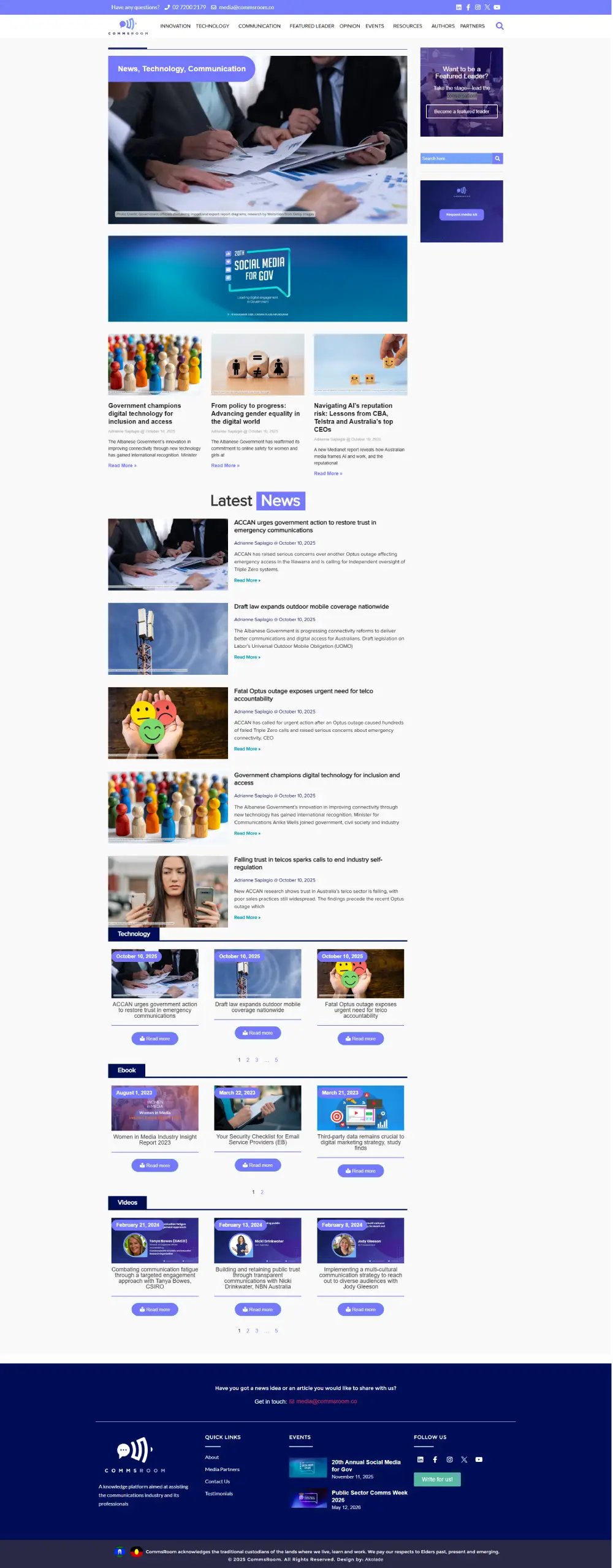
Comms Room, a leading communications newsletter website, wanted a modernized platform with a custom post type (CPT) setup to manage their daily articles and categorized content efficiently.
We developed a fully dynamic, user-friendly website that automates content organization, enhances navigation between topics, and supports high-volume publishing. The result is a sleek, modern platform that streamlines content management while elevating the reader experience — keeping Comms Room’s news delivery fast, engaging, and future-ready.