
Most organizations don’t have a leadership problem — they have a leadership pipeline problem. Research from DDI’s Leadership Trends 2026 report found that 77% of CHROs lack confidence in their bench strength for critical roles, while 71% of leaders report rising stress that pushes many toward burnout rather than growth. This case study explores how we helped a growing mid-market organization close that gap — building a competency framework, structured coaching, and a measurable development path that turned high-potential performers into ready leaders.
34% increase in internal promotion readiness, stronger engagement scores across the leadership population, and a leadership bench the organization could finally trust to lead through the next stage of growth.
The organization had no shortage of strong individual performers. What it lacked was a formal, repeatable way to prepare them for bigger roles. Promotions had become reactive — decided under pressure when a leader left, rather than planned years in advance.
Nearly four in five CHROs report the same blind spot: DDI’s 2026 Leadership Trends research found 77% lack confidence in their bench strength for critical positions, and only 19% of managers demonstrate strong delegation skills — the exact capability a thin bench depends on.

On paper, the business was healthy. Underneath, a handful of leaders were carrying disproportionate decision-making load, onboarding new managers inconsistently, and losing candidates to competitors offering clearer growth paths.
The risk wasn’t visible in quarterly results. It was visible in who the organization could not afford to lose.
“A leadership pipeline is not a list of names on a succession chart. It is a system that consistently produces leaders who are ready before the business needs them.”
Leadership & Organizational Development

Rather than starting with generic leadership traits, the engagement began by mapping the actual capabilities the business would need over the next three years — cross-functional decision-making, change leadership, and coaching others through ambiguity — then assessing every high-potential employee against that specific bar.
Each participant received an individualized development plan built around real business challenges rather than classroom theory: stretch assignments, structured 1:1 coaching, and regular calibration sessions with senior leadership to track readiness, not just participation.
Key improvements included:
Most importantly, leaders across the organization began coaching their own successors — turning a one-time program into an ongoing habit.
Leadership development is most valuable when it stops being an HR initiative and becomes part of how the business plans for growth.
For this organization, building leadership capability early meant future expansion, restructuring, or leadership transitions could happen without the disruption that comes from being caught unprepared. According to Harvard Business Impact’s 2025 Global Leadership Development Study, organizations that pair development with ongoing feedback — as 62% of high-performing companies now do — see that capability compound over time rather than fade after a single training cycle.
The engagement began with a full view of how leadership decisions actually got made across the business — who influenced them, where bottlenecks formed, and which capabilities were consistently missing when things went wrong.

Rather than relying on generic leadership competencies, the team built a role-specific framework tied to the organization’s actual strategic priorities — the situations future leaders would need to navigate, not abstract traits on a slide.
High-potential employees worked through structured 1:1 coaching alongside real assignments — leading a cross-functional project, managing a difficult stakeholder relationship, or owning a budget decision — with feedback built into each milestone rather than saved for an annual review.

Progress was tracked through calibration sessions with senior leadership rather than self-reported confidence, giving the organization an honest, shared view of who was ready for what — and where gaps still existed.
“The objective was never to create a class of employees who felt good about leadership. It was to create leaders who were demonstrably ready to carry more weight.”
Leadership & Organizational Development
The resulting framework outlived the first cohort. Managers began using the same assessment language in everyday coaching conversations, giving the organization a repeatable way to identify and prepare its next leaders — not just this year’s group.
The transformation changed how leadership decisions were made across the organization — not just who made them.

Promotions became proactive rather than reactive. Instead of scrambling when a leader left, the organization could point to two or three internally developed candidates who were already demonstrating readiness for the role.

Because every participant was assessed and coached against the same framework, decision-making style and communication became noticeably more consistent from team to team, reducing friction for employees who worked across departments.
Perhaps the most lasting impact was cultural. Leaders who had gone through the program began coaching others the same way they had been coached, extending the framework’s reach well beyond the original participants.
The engagement demonstrated that leadership transformation is not a training expense — it is a growth enabler. As DDI’s research points to an accelerating “Great Flattening” of management layers reshaping how organizations lead, the businesses that invest in leadership capability now will be the ones ready to operate with fewer layers and more empowered decision-makers.
The future of financial services is being shaped by digital innovation, evolving markets, and new forms of value. We help financial institutions, fintechs, and digital asset businesses turn change into opportunity and build for sustainable growth.
Ideas that drive better

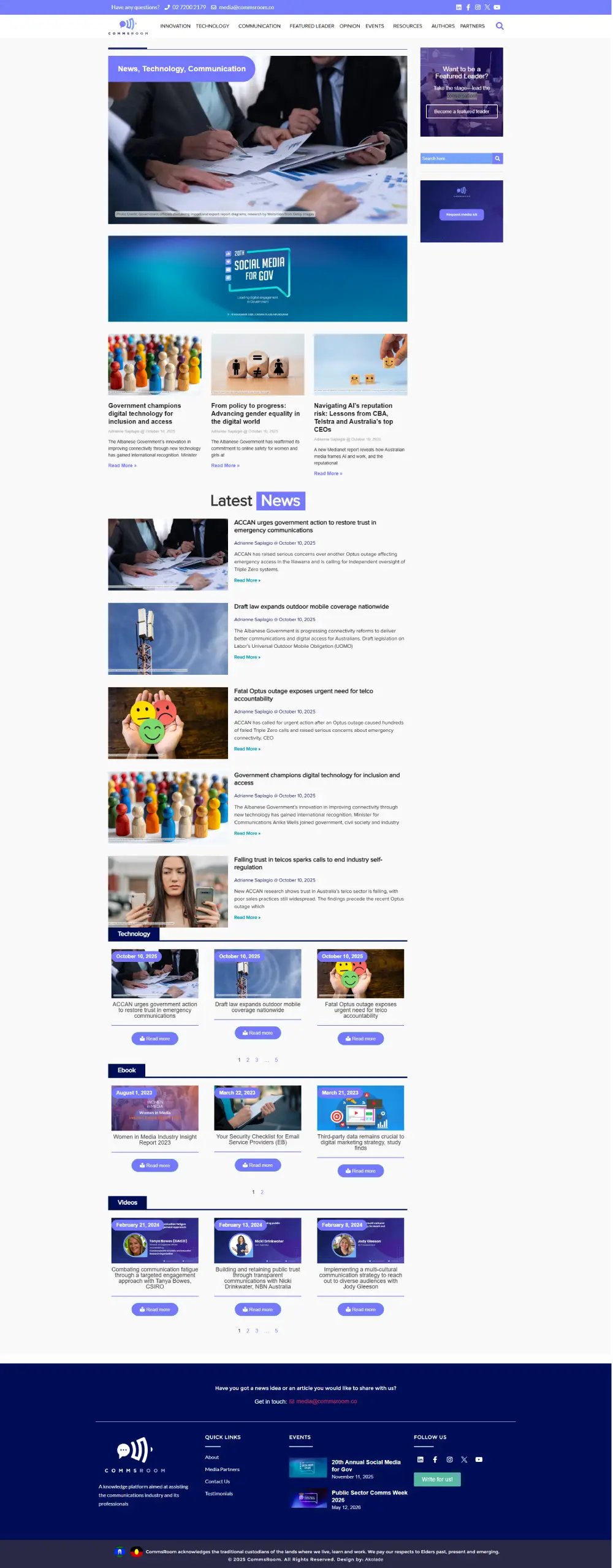
Comms Room, a leading communications newsletter website, wanted a modernized platform with a custom post type (CPT) setup to manage their daily articles and categorized content efficiently.
We developed a fully dynamic, user-friendly website that automates content organization, enhances navigation between topics, and supports high-volume publishing. The result is a sleek, modern platform that streamlines content management while elevating the reader experience — keeping Comms Room’s news delivery fast, engaging, and future-ready.