
Nearly two-thirds of U.S. family-owned businesses have no formal succession plan, and the share of family enterprises that survive beyond the founding generation has fallen from roughly one-third to one-fifth, according to the World Economic Forum. A third-generation manufacturing and distribution enterprise, built over four decades by its founding family, was staring down that exact statistic: an aging CEO with no documented transition plan, three adult children with unequal roles and unresolved expectations, and a leadership bench that had never been tested outside the founder’s shadow. Nova Capital Consulting was engaged to build the governance architecture and leadership pipeline the family had never had time to create.
The engagement replaced ambiguity with a documented succession framework, delivering a 92% independently assessed successor readiness score, full retention of senior non-family leadership through the transition, and three-times-faster executive decision-making once the new leadership structure was in place.
The business itself was healthy. Revenue had grown steadily for over a decade, the founder remained sharp and deeply respected, and the next generation was genuinely committed to the enterprise. But none of that stability was backed by a plan. Authority ran through one person’s judgment, and no one, including the founder, could say with confidence who would be running the company in five years, or under what terms.

Research from EY finds that more than 65% of family business owners want to pass their company to the next generation, but fewer than 25% actually succeed in doing so. In this family’s case, three siblings held informal, overlapping responsibilities with no defined decision rights and no forum for resolving disagreement before it became personal.
Family businesses rarely fail because the next generation isn't capable. They fail because no one ever built the structure that lets capability actually take over.
Family Business Advisory

Diagnostic interviews surfaced three converging risks: no objective way to evaluate successor readiness, no governance body separating family dynamics from business decisions, and no ownership framework aligned with the leadership plan. PwC’s most recent Family Business Survey found that 44% of U.S. family businesses report that succession planning has already affected their operations.
Every additional year without a documented plan compounded the risk: key non-family executives openly questioning their long-term future, customers and lenders beginning to ask succession-related due diligence questions, and siblings increasingly negotiating roles informally rather than on merit.
Key improvements included:
None of this required the family to abandon what made the business work. It required a framework flexible enough to hold their values while giving the next generation a real, defensible path to authority.
That framework was built to scale with the business, not just to get one handover done. As the company grows and a fourth generation eventually enters the picture, the same governance architecture is designed to absorb that transition too.
Nova Capital Consulting designed a structured, phased succession program built around four pillars: successor readiness, governance architecture, leadership transition sequencing, and ownership alignment, developed in coordination with the family’s existing legal and estate advisors.

Each of the three next-generation candidates went through a structured readiness assessment covering operational competence, financial acumen, external stakeholder credibility, and leadership judgment under pressure. As reporting on the Family Business Institute’s research notes, only about 30% of family-owned businesses survive into the second generation, and undocumented succession decisions are consistently cited as a root cause.
Nova Capital Consulting established a family council, distinct from the operating board, with a written charter defining decision rights and escalation paths. Research shows only about 12% of family businesses make it to a third generation, largely because governance never catches up to the growing complexity of a larger family.

Rather than a single handover date, the transition was sequenced across 18 months in defined stages: shared operating authority, supervised P&L ownership, external stakeholder representation, and finally full CEO authority with the founder shifting to a chairman and mentor role.
A transition plan only works if it's built in stages the whole family can see and trust. That's what turns a handover from a risk into a milestone.
Generational Transition Strategy
Nova Capital Consulting worked alongside the family’s estate and legal counsel to ensure the emerging leadership plan and the ownership transfer structure were pointed in the same direction, including voting rights and buy-sell provisions for non-active siblings.
The designated successor achieved a 92% score on the independent readiness assessment before assuming full CEO authority, evaluated against the same operational, financial, and leadership benchmarks used at the outset.

Every senior non-family executive who was with the company at the start of the engagement remained through the full transition and beyond, a direct result of the retention commitments and clarity built into the governance charter.
With decision rights formally defined between the family council and the operating board, major strategic and capital decisions now move roughly three times faster, without sacrificing family alignment.

The family council charter, readiness assessment framework, and phased transition model were all designed as reusable infrastructure. As younger family members enter the business, the same succession criteria and governance cadence apply.
Perhaps the most durable outcome wasn’t a single metric. It was the model itself — now the family’s standard approach to every future leadership question, not a one-time deliverable that ends with this transition.
Family enterprises that treat succession as infrastructure, not an event, protect more than their own business. The World Economic Forum notes that family businesses generate roughly 64% of U.S. GDP and 78% of new job creation, making disciplined generational transitions a matter of broader economic resilience, not just individual legacy.
The future of financial services is being shaped by digital innovation, evolving markets, and new forms of value. We help financial institutions, fintechs, and digital asset businesses turn change into opportunity and build for sustainable growth.
Ideas that drive better

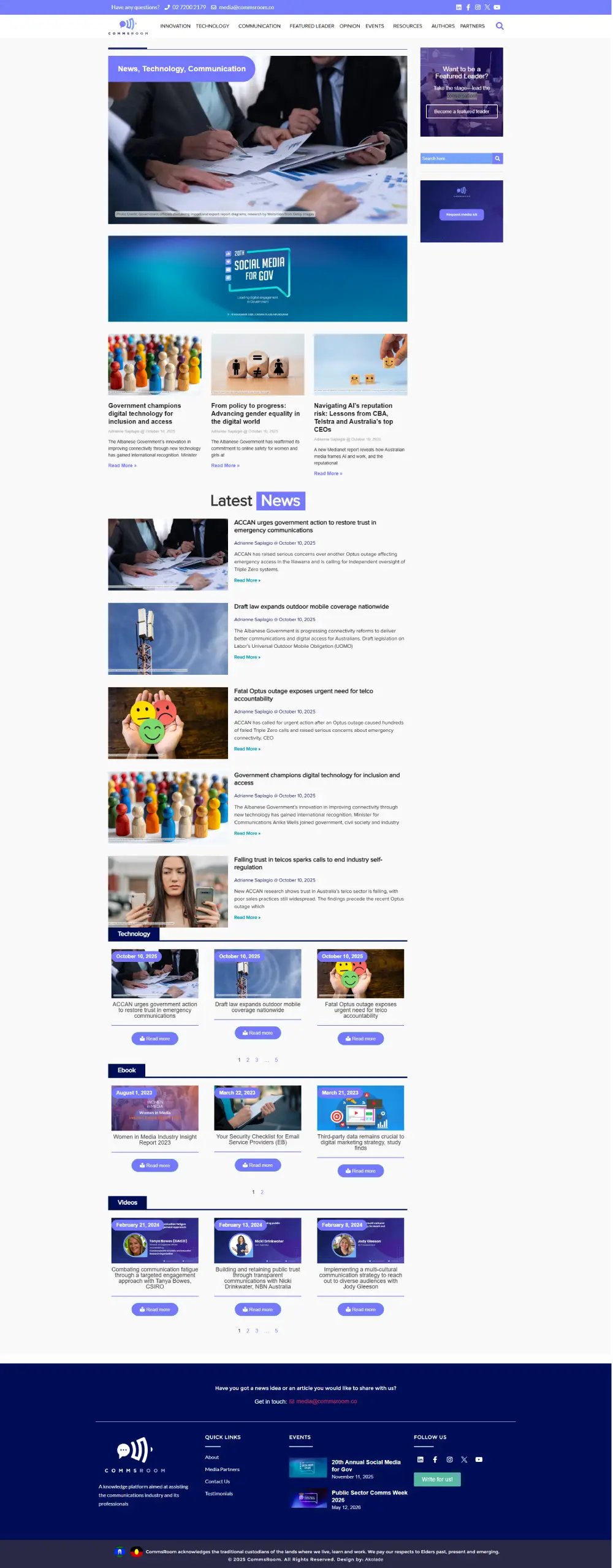
Comms Room, a leading communications newsletter website, wanted a modernized platform with a custom post type (CPT) setup to manage their daily articles and categorized content efficiently.
We developed a fully dynamic, user-friendly website that automates content organization, enhances navigation between topics, and supports high-volume publishing. The result is a sleek, modern platform that streamlines content management while elevating the reader experience — keeping Comms Room’s news delivery fast, engaging, and future-ready.