
Most digital investment doesn’t fail because the technology is wrong. It fails because growth outpaces the operating model behind it. McKinsey research finds that 45% of digital transformations underperform their own profit expectations, and the pattern is almost always the same: leadership adds tools and headcount to keep pace with demand, but the underlying processes stay manual, disconnected, and dependent on individual effort. A fast-growing, multi-location services organization arrived at Nova Capital Consulting in exactly this position, with client volume climbing quarter over quarter, but onboarding, invoicing, and reporting still running through a patchwork of spreadsheets, email approvals, and point tools never designed to scale.
Working with Nova Capital Consulting to rebuild its digital operating model, the organization cut manual processing time by 46%, scaled transaction volume 3.2x without adding proportional headcount, and compressed its monthly reporting cycle by 68% — turning fragmented growth into a repeatable, predictable expansion engine.
The organization had spent three years in high-growth mode, expanding from a single market into several new regions and more than doubling its client base. On paper, the business was a success story. Underneath, growth was being absorbed almost entirely by people, not systems — every new client, invoice, and report added manual work rather than leveraging a process that already existed.

Boston Consulting Group’s Digital Acceleration Index found that 40% of the most digitally mature companies grew revenues by more than 10%, compared with just 19% of digital laggards, a gap driven less by strategy and more by whether the underlying operating infrastructure could actually support growth. Every new market required a proportional increase in operations headcount, and the business had no reliable way to know its real-time performance until the numbers were reconciled, by hand, weeks later.
Growth exposes whatever your operating model was hiding. The businesses that scale predictably are the ones whose processes, data, and systems were built to carry more weight than they currently do.
Digital Growth Strategy

A diagnostic across the client’s operations revealed 14 overlapping platforms, several purchased to solve the same problem in different departments. BetterCloud’s 2026 State of SaaS research shows the average organization’s SaaS portfolio has grown toward 118 applications, up from just 8 a decade earlier. For the client, the sprawl meant duplicate data entry and a reporting process requiring manual reconciliation from five different systems every month.
None of these issues were visible in any single transaction. They showed up in the aggregate, as slower onboarding, delayed invoicing, and a leadership team making expansion decisions on data that was already a month old. The organization needed infrastructure that gave leadership a live view of the business rather than a historical one.
Key improvements included:
None of this required a wholesale technology overhaul. It required a deliberate, sequenced approach to rationalizing the tools already in place and building the data infrastructure to make growth visible instead of reactive.
The goal from day one was not simply to fix what was broken, but to build an operating model that would still hold at twice the current size — infrastructure built to scale, not just to catch up.
Nova Capital Consulting approached the engagement as an operating model redesign, not a software rollout. The work was sequenced across four phases: tech stack rationalization, process digitization, workflow automation, and scalable reporting infrastructure, each building on the last so the organization never had to pause operations to implement change.

The first phase was subtraction, not addition. Nova Capital audited all 14 platforms against actual usage, retiring or merging tools with overlapping capability and standardizing on a core stack of five integrated systems. McKinsey research estimates current technology could automate work activities that absorb 60 to 70% of employees’ time today, much of it reachable simply by connecting systems that had never been integrated.
With a rationalized stack in place, Nova Capital mapped the client’s highest-friction workflows and rebuilt each one as a digital, largely automated process. This shift toward automated, data-driven operations mirrors a broader trend: 65% of B2B organizations are expected to shift from gut-feel to data-driven strategies by 2026.

Nova Capital then built a centralized reporting layer that pulled live data directly from the core systems, replacing the manual monthly reconciliation process with dashboards leadership could check in real time.
The technology was never the constraint. The constraint was that nobody had connected it into a single, reliable operating rhythm.
Operations & Automation Advisory
The final phase focused on adoption and governance: documented standard operating procedures for every redesigned workflow, role-based training for existing staff, and an onboarding playbook so new hires and new regional teams could plug into the same systems from day one.
Within two full operating quarters of the engagement, the results showed up in both the numbers and the day-to-day experience of running the business. Growth no longer meant proportional strain — it meant throughput.

Manual processing time across onboarding, invoicing, and approvals dropped by 46%, and the organization absorbed a 3.2x increase in transaction and client volume without a proportional increase in operations headcount.
The monthly reporting cycle compressed by 68%, from roughly five days of manual reconciliation to under two. Expansion decisions once made on data three to four weeks old are now made on current performance.

Consolidating from 14 platforms to 5 integrated systems cut redundant software spend by roughly a third and eliminated the duplicate data entry that had been the organization’s leading source of client-record errors.
The documented processes, integrated stack, and reporting infrastructure built during the engagement are reusable by design. Launching in a new market or standing up a new service line no longer means reinventing the operating model.
Digital scaling is not a one-time project. It’s an operating discipline that compounds. McKinsey’s research on transformation outcomes found that organizations that follow a disciplined set of transformation practices are roughly five times more likely to exceed their performance expectations than those that don’t.
The future of financial services is being shaped by digital innovation, evolving markets, and new forms of value. We help financial institutions, fintechs, and digital asset businesses turn change into opportunity and build for sustainable growth.
Ideas that drive better

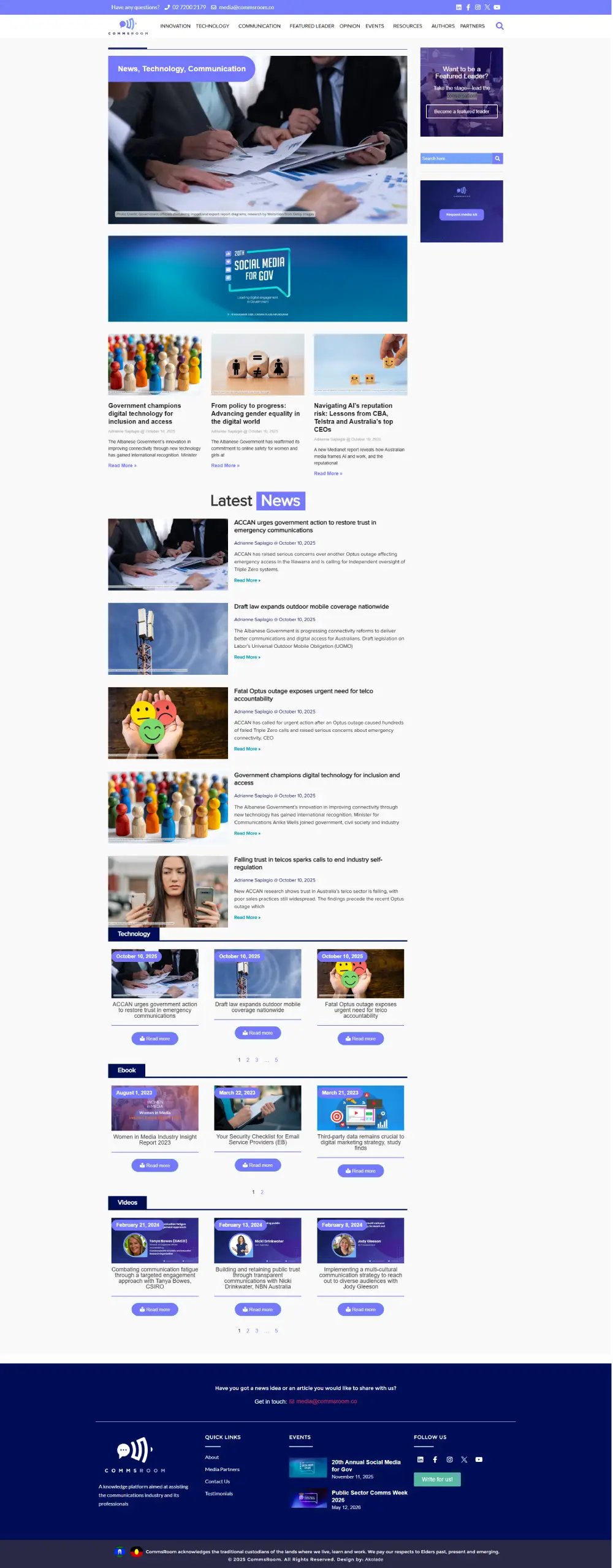
Comms Room, a leading communications newsletter website, wanted a modernized platform with a custom post type (CPT) setup to manage their daily articles and categorized content efficiently.
We developed a fully dynamic, user-friendly website that automates content organization, enhances navigation between topics, and supports high-volume publishing. The result is a sleek, modern platform that streamlines content management while elevating the reader experience — keeping Comms Room’s news delivery fast, engaging, and future-ready.