
A full pipeline and a predictable quarter are not the same thing, and few sales organizations learn that distinction the easy way. A mid-market B2B technology distributor came to Nova Capital Consulting after three consecutive quarters of forecast misses, despite a pipeline that, on paper, was growing. Deals were multi-threaded, complex, and slower to close than ever, a pattern showing up across B2B sales broadly as buying committees expand and deal cycles stretch, as documented in Gong’s research on multi-threading and team selling. Leadership needed to know whether the problem was the market, the people, or the process. It turned out to be all three, and fixable in that order.
The client’s sales organization had scaled from 22 to 64 reps across four regions in under two years, but its systems, definitions, and coaching cadence had not scaled with it. Regional VPs ran forecast calls off gut feel because the CRM data underneath them was unreliable, and pipeline reviews had become an exercise in negotiating optimism rather than examining evidence. The board had started discounting every forecast by 20 to 30 percent before believing it, which is its own kind of organizational failure.

Nova Capital’s diagnostic found the client’s forecast accuracy sitting at roughly 54 percent by close of quarter, squarely inside the range most B2B teams operate in but well below the confidence executives assumed they had. That gap is common: research tied to Gartner’s forecasting analysis, summarized by Clari’s review of the findings, notes that more than half of sales leaders lack high confidence in the accuracy of their own forecasts. For this client, that uncertainty was compounding: finance was building headcount and marketing spend plans off numbers sales leadership itself didn’t trust.
The pipeline wasn't lying to them. It was reflecting exactly what four regions with four different definitions of a qualified deal would produce. Nobody had built a forecast; they had built an aggregation of opinions.
Sales Performance Practice

Stage definitions in the CRM existed in name only. One region moved a deal to “Commit” after a single positive call; another required signed procurement approval. Deal scoring relied on rep self-assessment with no behavioral signals behind it, no multi-threading requirement, and no standardized discovery framework. The result was a pipeline that looked healthy in aggregate and was structurally unreliable underneath, with roughly 40 percent of “committed” deals slipping a quarter or disappearing entirely.
New reps were taking an average of 7.5 months to reach full productivity, well past the client’s planned five-month target, and onboarding consisted largely of shadowing whichever senior rep had time that week. With hiring accelerating to support growth targets, that ramp drag was functioning as a hidden tax on every dollar of sales headcount investment, and it was suppressing quota attainment org-wide well below where leadership believed it stood.
Key improvements included:
None of this was a talent problem. The reps were closing business; the organization simply couldn’t see, predict, or reliably repeat how. That distinction shaped everything about the engagement design that followed.
Nova Capital scoped a 16-week engagement structured around three commitments: rebuild pipeline definitions around evidence rather than sentiment, compress ramp time with a structured playbook, and install forecast governance the board could trust without a discount applied.
Nova Capital’s Sales Performance team didn’t start with new software. It started by rebuilding the definitions the software was supposed to enforce, then layered process, coaching, and governance on top of a foundation that could actually hold weight. The engagement ran in three parallel tracks: pipeline architecture, rep ramp acceleration, and forecast governance.

The team rebuilt the CRM’s stage-gate logic around observable buyer behavior rather than rep judgment: confirmed economic buyer engagement, documented pain quantification, and a mutual close plan became hard requirements to advance a deal, not optional fields. This mattered because sellers were already stretched across too many disconnected systems and manual entry points; Salesforce’s State of Sales research finds that reps spend roughly 60 percent of their time on non-selling tasks like CRM data entry and internal approvals. Nova Capital consolidated the client’s stage criteria into a single automated framework so accurate pipeline data became a byproduct of normal selling activity, not extra work layered on top of it.
Every open opportunity was rescored using a weighted model built from the client’s own closed-won and closed-lost history, factoring multi-threading depth, engagement recency, and competitive presence rather than a rep’s self-reported confidence. Deals lacking a second confirmed contact were automatically flagged for coaching intervention before they could advance, closing off the single largest source of late-stage forecast slippage the diagnostic had uncovered.

Nova Capital built a structured onboarding curriculum with weekly certification checkpoints, live call shadowing quotas, and a defined first-30-deals playbook rather than open-ended mentorship. Regional managers were retrained on a common coaching rubric so a rep’s development no longer depended on which region, or which mentor, they happened to land with.
We didn't ask reps to sell differently. We asked the system to finally reward the behaviors that were already correlated with winning, and to stop rewarding the ones that weren't.
Sales Performance Practice
The team installed a three-tier forecast structure, commit, best case, and pipeline, with explicit criteria for each category and a weekly cross-regional forecast call where managers defended movement between tiers using the new behavioral data rather than instinct. Finance was brought into the cadence directly, closing the trust gap between what sales reported and what the business planned against.
Within two full quarters of implementation, the client’s sales organization moved from a pipeline leadership had learned to distrust to one the board planned against without a discount. The shift showed up in the numbers finance cared about most: forecast accuracy, win rate, and how fast revenue actually moved through the funnel.

Forecast accuracy at quarter-close rose from a 54 percent baseline to 91 percent, placing the client’s forecasting discipline in the top tier of B2B sales organizations. That shift is significant against the broader market: the average B2B win rate sits around 21 percent industry-wide, according to HubSpot’s sales statistics research, and most organizations never build the qualification rigor needed to forecast confidently against that baseline. The client’s board stopped discounting sales-reported numbers within two quarterly cycles.
Win rate across core segments rose 32 percent as the multi-threading requirement and behavioral scoring model filtered out deals that were never going to close and gave reps earlier, clearer signal on where to invest their time. Regional variance in win rate, previously as wide as 14 percentage points between the strongest and weakest region, narrowed to under 5 points.

Average sales cycle length dropped 24 percent as the mutual close plan requirement forced earlier alignment on buyer timelines and eliminated the late-stage stalls that previously ate weeks out of every deal. Shorter cycles didn’t just close revenue faster, they freed up meaningful rep capacity that flowed directly into higher deal volume per rep without adding headcount.
New-rep ramp time fell from 7.5 months to 4.2 months under the structured onboarding playbook, and quota attainment for reps in their first year rose from 41 percent to 68 percent. For a sales organization still hiring against growth targets, that compression translated directly into faster payback on every new rep the client brought on.
What changed for this client reflects a gap playing out across B2B sales broadly. Benchmarking research shows average B2B organizations forecasting in the 50 to 70 percent accuracy range while top performers reach 80 to 95 percent, a spread detailed in forecasting accuracy benchmarks now widely cited across the industry. Closing that gap is rarely a tooling problem first; it is a definitions, discipline, and governance problem that most organizations never diagnose correctly. For companies scaling sales headcount into 2026 and beyond, the difference between a pipeline that looks full and a pipeline that behaves predictably is the difference between growth that compounds and growth that has to be renegotiated every quarter.
The future of financial services is being shaped by digital innovation, evolving markets, and new forms of value. We help financial institutions, fintechs, and digital asset businesses turn change into opportunity and build for sustainable growth.
Ideas that drive better

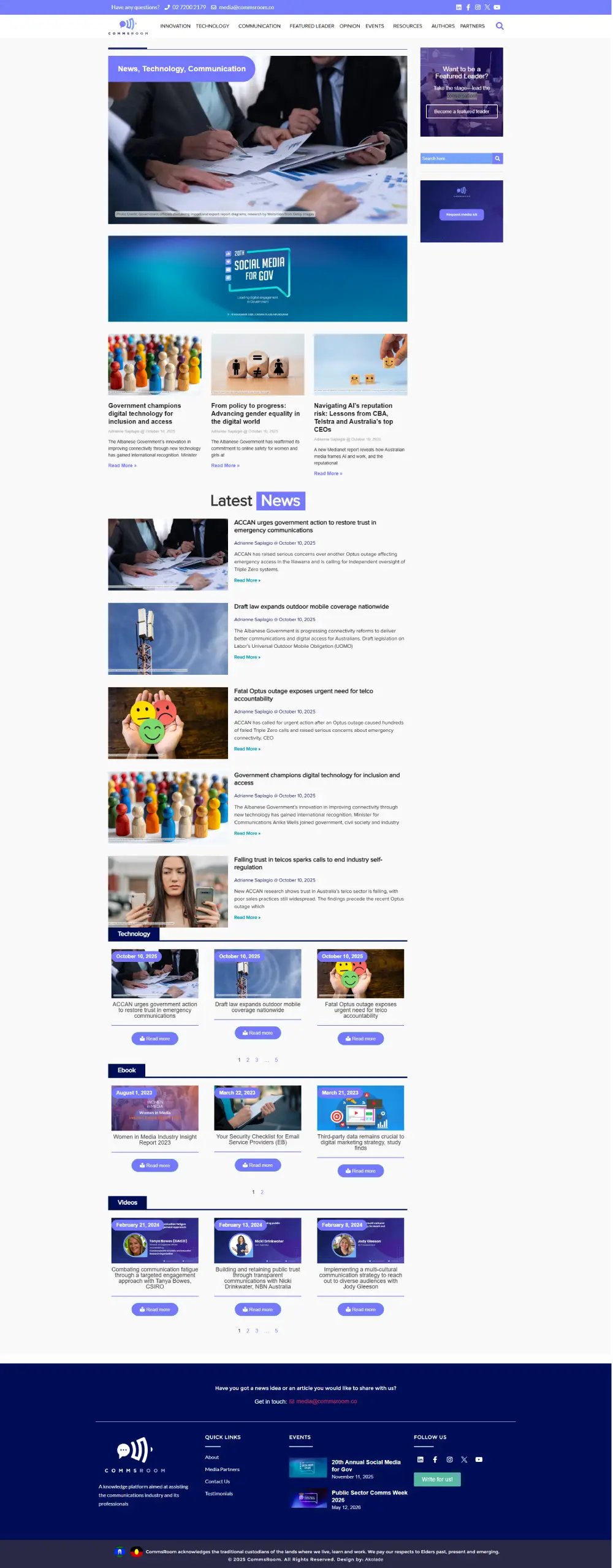
Comms Room, a leading communications newsletter website, wanted a modernized platform with a custom post type (CPT) setup to manage their daily articles and categorized content efficiently.
We developed a fully dynamic, user-friendly website that automates content organization, enhances navigation between topics, and supports high-volume publishing. The result is a sleek, modern platform that streamlines content management while elevating the reader experience — keeping Comms Room’s news delivery fast, engaging, and future-ready.