
Entering a new market is easy to announce and hard to get right. 72% of global businesses are currently pursuing expansion plans, but ambition alone isn’t a strategy — as Target discovered when its rushed entry into Canada resulted in a $2.1 billion loss. This case study explores how we helped a growing organization enter three new regions deliberately: assessing real market potential, adapting the offer to local expectations, and building a go-to-market plan built for the realities of each market rather than a copy-paste of what worked at home.
30% revenue growth in new markets within two years, successful entry into three regions, and a repeatable framework for evaluating the next one.
The organization had a proven model in its home market and real pressure to grow beyond it — from investors, from competitors already moving into adjacent regions, and from a leadership team eager for the next chapter. What it didn’t have yet was a disciplined way to decide where to go, and how.

Early internal discussions leaned heavily on gut feel — markets that “felt” similar to the home market, based on language or geography rather than actual demand, competitive intensity, or regulatory friction. That’s precisely the gap that sinks expansions: Hanover Research’s market entry framework points to inadequate assessment of market viability, competitors, and customer needs as the most common causes of costly missteps.
“The businesses that expand successfully aren't the ones that move fastest. They're the ones that know exactly why a market will work before they commit capital to it.”
Growth & Market Strategy

The engagement began by studying expansion failures as closely as successes. Target’s $2.1 billion loss in Canada remains one of the clearest cautionary tales — a rushed rollout, an under-localized supply chain, and pricing that didn’t match local expectations. The lesson wasn’t to avoid risk, but to remove the avoidable kind.
Using a structured evaluation across market size, growth trajectory, regulatory complexity, and competitive intensity, the organization narrowed a list of a dozen candidate markets down to three with genuinely strong fundamentals — not just familiarity.
Key improvements included:
Most importantly, expansion decisions stopped being driven by whoever argued loudest in the room, and started being driven by evidence every stakeholder could see.
Market expansion is most powerful when it’s treated as a repeatable capability rather than a single high-stakes bet.
For this organization, building that discipline meant the third market entry took a fraction of the time and risk of the first — and set the foundation for a fourth.
The team began with a wide-lens assessment of candidate markets — sizing demand, growth trajectory, regulatory environment, and competitive intensity — before a single resource was committed to any of them.

Using a framework rooted in the Ansoff Matrix, the organization distinguished between lower-risk market development opportunities and higher-risk moves that would stretch both the product and the market at once — and prioritized accordingly.
Pricing, packaging, and even the core value proposition were re-tested against local customer research in each target market, following the same discipline Hanover Research’s market entry framework recommends: understanding customer needs before finalizing the product for a new market.

Rather than entering all three markets simultaneously, the organization staged entry so that lessons from the first market directly informed execution in the second and third — cutting both cost and risk with each successive launch.
“Every market taught us something the last one couldn't. The goal was never to get expansion perfect the first time — it was to get better, faster, with every market after that.”
Growth & Market Strategy
In markets with meaningful regulatory or distribution complexity, the organization prioritized local partnerships over building every capability from scratch — accelerating time-to-market without sacrificing quality of execution.
The expansion strategy changed more than the organization’s geographic footprint — it changed how confidently the business could pursue its next opportunity.

The organization achieved 30% revenue growth in its new markets within two years — a result made possible by entering deliberately rather than quickly.

With a proven evaluation framework in place, leadership could assess the next expansion opportunity with far greater confidence — and far less reliance on assumption or urgency.
The market evaluation and entry framework built during this engagement became a standing capability, ready to be applied to the organization’s fourth market and beyond.
The engagement demonstrated that market expansion, done deliberately, compounds. With 72% of global businesses currently chasing growth beyond their home markets, the organizations that succeed won’t be the ones that move fastest — they’ll be the ones that build the discipline to expand well, market after market.
The future of financial services is being shaped by digital innovation, evolving markets, and new forms of value. We help financial institutions, fintechs, and digital asset businesses turn change into opportunity and build for sustainable growth.
Ideas that drive better

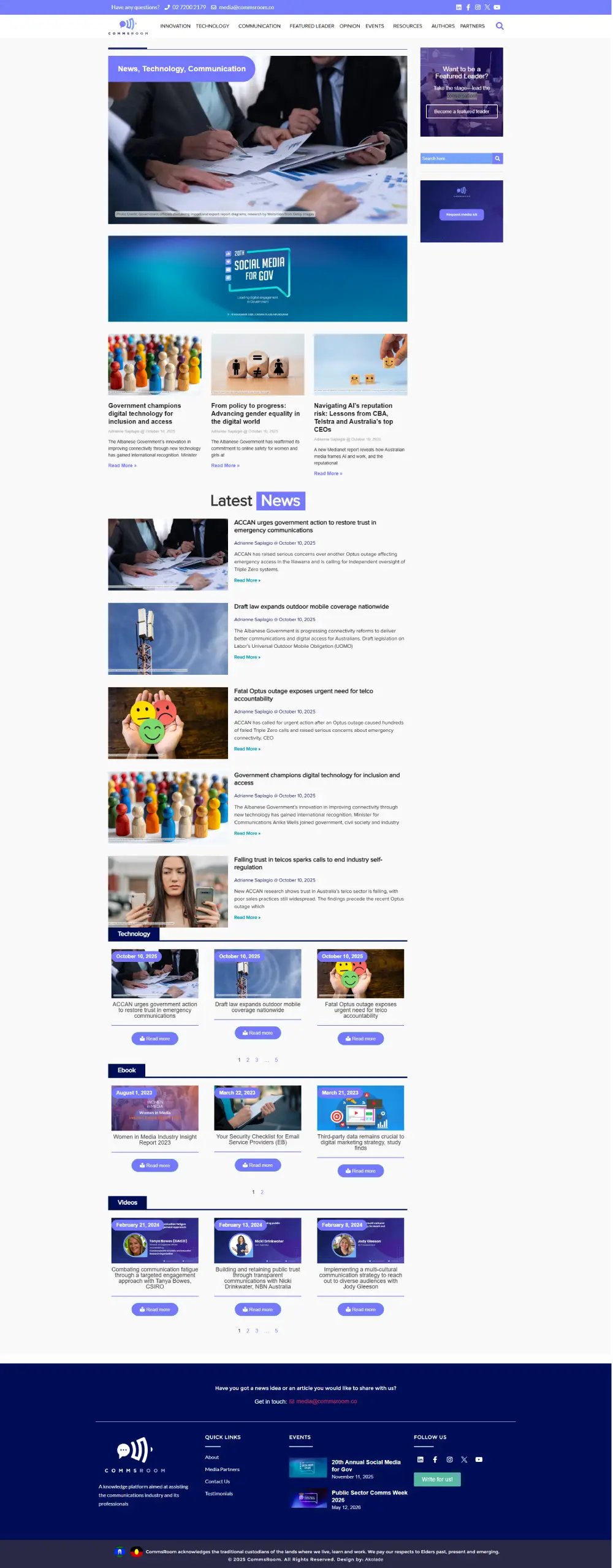
Comms Room, a leading communications newsletter website, wanted a modernized platform with a custom post type (CPT) setup to manage their daily articles and categorized content efficiently.
We developed a fully dynamic, user-friendly website that automates content organization, enhances navigation between topics, and supports high-volume publishing. The result is a sleek, modern platform that streamlines content management while elevating the reader experience — keeping Comms Room’s news delivery fast, engaging, and future-ready.