
Margin pressure has stopped being a cyclical worry and become a permanent line on the CFO’s agenda. In Deloitte’s most recent CFO Signals survey, 52% of CFOs named cost management their top internal risk, with nearly half pointing directly to shrinking profit margins as the cause. For one mid-market industrial distributor, that pressure had stopped being an abstract trend line and started showing up in board meetings: input costs, wages, and freight kept climbing while price increases lagged behind, and nobody could say with confidence which products, customers, or business units were actually profitable anymore.
Working alongside the company’s finance and operations leadership, Nova Capital Consulting replaced reactive, across-the-board budget cuts with a disciplined, zero-based cost transformation, reducing addressable operating costs by 22%, lifting EBITDA margin by 6.4 points, and capturing $5.1M in annualized savings that held into the second full year rather than eroding after the first.
The company had grown steadily through a mix of organic expansion and two bolt-on acquisitions, but its cost base had never been rebuilt to match. Budgets were still set the old way, take last year’s number, add a few percentage points, and move on. SG&A had crept upward year after year, vendor contracts had auto-renewed without a second look, and finance had no reliable view of which product lines or customer accounts were actually generating margin.

Leadership had already tried the obvious first move: an across-the-board expense freeze, followed by a round of discretionary spending cuts. Costs dipped for two quarters, then crept back. McKinsey’s analysis of S&P Global 1200 companies found that only one in four companies were able to sustain G&A cost reductions for a full four years after announcing them.
Indiscriminate cost-cutting buys you a quarter or two of relief and then quietly gives it back. The companies that make cost reduction stick treat it as a redesign of how money gets spent.
Cost & Margin Strategy

Nova Capital Consulting’s diagnostic mapped every major cost category against revenue growth and found SG&A expanding nearly twice as fast as top-line sales, with vendor spend fragmented across more than 340 active suppliers. This matched a pattern Bain has documented: in a study of 470 companies, only 12% of cost transformations delivered performance improvements that actually held over time.
Before any savings target was set, Nova Capital Consulting worked with the CEO, CFO, and business unit leaders to agree on a mandate: this would be a rebuild of the cost base, not a blanket cut. Capability that drove revenue, service quality, or product differentiation would be protected.
Key improvements included:
None of these moves were designed as a one-time correction. Each was built as a mechanism the company’s own finance team could operate independently once Nova Capital Consulting stepped back.
That was the real design constraint from day one: a cost structure built to scale, so that the next phase of growth wouldn’t require another emergency reset five years from now.
Nova Capital Consulting designed the engagement around four connected disciplines: rebuilding the budget from zero, seeing true profitability by customer and product, renegotiating and consolidating the vendor base, and automating the transactional work that no longer needed a human doing it manually.

Rather than trimming the existing budget, every department built its spending plan from a blank page. This is the core discipline behind zero-based budgeting: it forces spend to be re-earned annually instead of inherited by default. Roughly a third of SG&A lines had no clear owner able to explain what business outcome the spend supported.
Aggregate margin numbers had been masking a wide spread underneath. Nova Capital Consulting built a cost-to-serve model that allocated fulfillment, service, and support costs down to the individual customer and product line, the same discipline behind analyses like Deloitte’s cost-to-serve work.

With spend visibility in hand, procurement moved from reactive renewals to competitive rebidding across the top 80% of vendor spend by value. Hackett Group’s benchmarking work ties structured procurement redesign to sharply lower maverick spend.
The vendor list wasn't the real problem. The absence of anyone accountable for it was. Once procurement had clean spend data and a mandate to compete every category, the savings showed up on their own.
Procurement & Vendor Strategy
The final stream targeted the manual, repetitive work absorbing hours across finance and procurement, invoice matching, purchase order approvals, and vendor onboarding, and automated it. Freed capacity was redirected into customer-facing and revenue-generating functions instead of eliminated outright.
Eighteen months after the engagement began, the results were structural rather than cosmetic, the kind of change that shows up in the following year’s numbers too, not just the first one.

Addressable operating costs fell 22%, but headcount in customer-facing, sales, and service delivery roles was preserved and, in several cases, strengthened by capacity redeployed from automated back-office work.
EBITDA margin improved by 6.4 points, translating to $5.1M in annualized savings. The cost-to-serve analysis alone informed pricing and service-level changes on the least profitable accounts.

Twelve months in, savings hadn’t just held, they’d compounded, with the zero-based budget process now running as the company’s standard annual cycle rather than a one-time project.
By the end of the engagement, the finance team owned the zero-based budgeting cycle, the cost-to-serve model, and the procurement rebidding calendar independently of Nova Capital Consulting.
The company is now evaluating its next acquisition from a materially stronger financial position. As McKinsey notes in its research on sustaining efficiency gains, the real value of cost management comes from building on initial savings continuously rather than treating them as a one-time event.
The future of financial services is being shaped by digital innovation, evolving markets, and new forms of value. We help financial institutions, fintechs, and digital asset businesses turn change into opportunity and build for sustainable growth.
Ideas that drive better

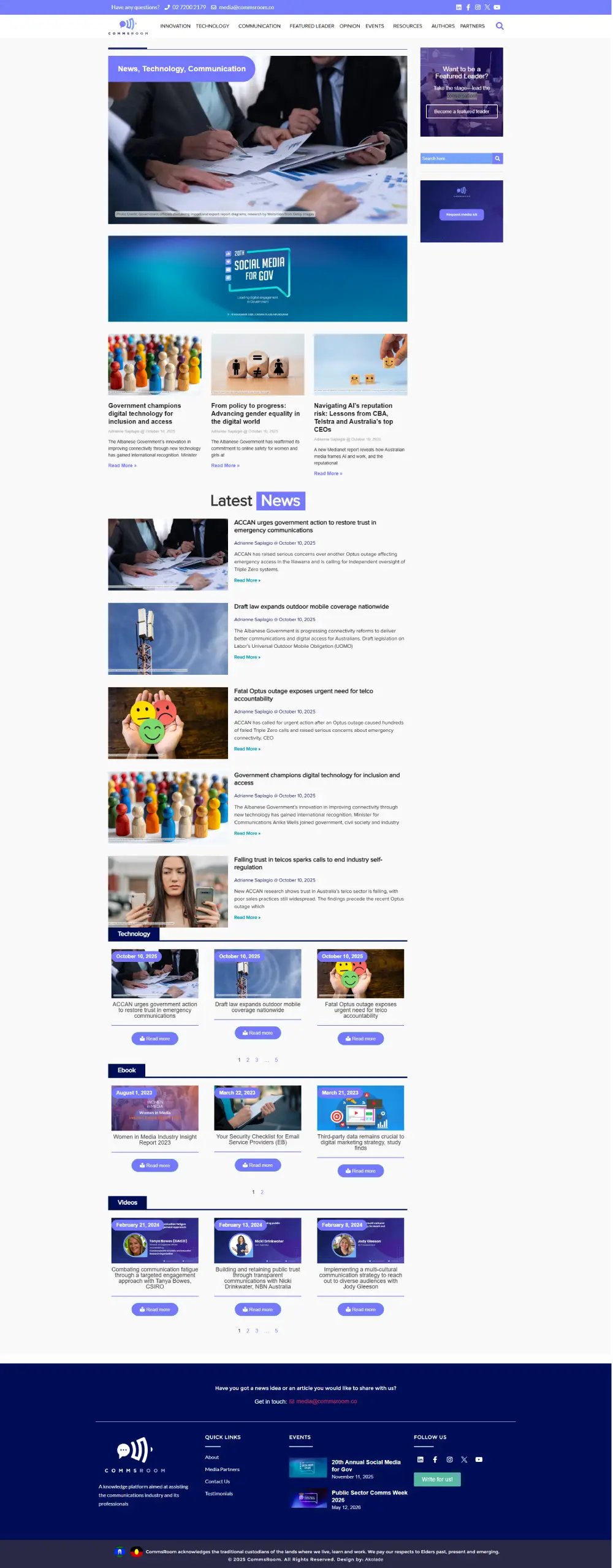
Comms Room, a leading communications newsletter website, wanted a modernized platform with a custom post type (CPT) setup to manage their daily articles and categorized content efficiently.
We developed a fully dynamic, user-friendly website that automates content organization, enhances navigation between topics, and supports high-volume publishing. The result is a sleek, modern platform that streamlines content management while elevating the reader experience — keeping Comms Room’s news delivery fast, engaging, and future-ready.