
Eighteen months before a planned growth-equity raise, the executive team at a $180 million specialty manufacturer looked, on paper, like a strength: eight experienced functional leaders, a founder-CEO with a clear five-year vision, and a board that trusted the group to execute. In practice, the team had become the company’s single biggest execution risk. Strategic priorities agreed upon in quarterly offsites quietly reverted to departmental agendas within weeks. Cross-functional initiatives stalled in ambiguous ownership. And the CEO was spending an estimated 30 percent of her time re-litigating decisions the team had supposedly already made.
Nova Capital Consulting was engaged to diagnose the root causes of the misalignment and rebuild the executive team’s operating model before the capital raise process began. What follows is how a six-month engagement moved this leadership team from surface-level consensus to genuine, measurable alignment — and what changed operationally, financially, and culturally as a result.
On paper, the executive team had every ingredient for high performance: functional depth, tenure, and a CEO who ran disciplined quarterly planning sessions. But Nova’s initial stakeholder interviews surfaced a pattern common to teams under pre-exit pressure — leaders nodded along to enterprise priorities in the room, then returned to their functions and quietly reprioritized around what their own P&L or team needed most. Nobody was acting in bad faith. Nobody was naming it, either.
The result was a strategic plan that existed on a slide deck but not in the actual sequencing of work. Three separate functional leaders described the same cross-functional initiative — a new customer onboarding process spanning sales, operations, and finance — as their “top priority,” yet none had allocated a resource to lead it end to end.

This pattern is more common than most executive teams admit. A McKinsey analysis of team effectiveness found that roughly three in four cross-functional teams underperform against their own stated goals, and that trust and decision-making discipline — not talent density — account for the majority of the performance gap between high- and low-functioning teams. Nova’s diagnostic work confirmed the same dynamic at the executive level: the individual leaders were strong performers, but the team, as a decision-making unit, was underperforming its own capability.
A structured diagnostic — combining confidential 1:1 interviews, a decision-rights audit, and a review of the last four quarters of strategic initiative status reports — quantified what leadership had sensed but couldn’t name. Of 14 initiatives flagged as “strategic priorities” in the prior year’s planning cycle, only 6 had a single accountable owner. The rest were shared, contested, or undefined.
When we mapped who actually believed they owned each strategic initiative, three of our fourteen priorities had four different executives each convinced it was theirs to drive. That is not a resourcing problem. That is a team that has never agreed, out loud, on how it makes decisions.
Organizational Effectiveness Practice

The diagnostic didn’t stop at counting orphaned initiatives. Nova Capital’s team traced each gap back to a specific decision-rights ambiguity or unresolved disagreement, building a structural map of exactly where the executive team’s stated priorities diverged from its actual behavior.
The diagnostic also surfaced a behavioral root cause: the executive team had optimized for harmony over honesty. Disagreements were resolved in side conversations after meetings rather than in the room where decisions were made, which meant every “agreement” carried an asterisk. Functional leaders left planning sessions with materially different interpretations of the same commitments — not because they misunderstood the words, but because unresolved tension had never been surfaced enough to force real clarity.
This is consistent with what practitioners are now documenting industry-wide: performative consensus, where teams mistake the absence of visible conflict for genuine alignment, is one of the more expensive blind spots in senior leadership. The gap between how aligned a team believes it is and how aligned it actually behaves rarely shows up until a deadline is missed or a capital event forces the question.
Key improvements included:
The diagnosis reframed the engagement. This was not a strategy problem — the five-year plan itself was sound. It was a team operating system problem: the executive group lacked a shared, disciplined way of surfacing disagreement, assigning ownership, and holding each other accountable between offsites.
With the baseline established and the pattern named, the engagement moved into design: rebuilding how this specific executive team made decisions, resolved conflict, and tracked follow-through — not a generic leadership training program, but an operating rhythm built for this team’s actual dysfunctions.
Nova’s intervention was deliberately narrow and behavioral rather than broad and aspirational. Rather than a values refresh or an off-the-shelf leadership workshop, the engagement centered on three interlocking mechanisms: a redesigned decision-rights framework, a structured conflict-surfacing protocol built into every executive meeting, and a single-owner accountability model for every enterprise-level initiative.
The work began with a two-day executive alignment session, but unlike the team’s prior offsites, this one was explicitly designed to make disagreement visible and productive rather than something to be smoothed over before lunch.

This distinction matters. As recent research on executive team dynamics has argued, top teams that mistake harmony for alignment tend to defer conflict rather than resolve it — and that deferred conflict resurfaces later, more expensively, as execution failure. Nova facilitators used a structured disagreement protocol at the two-day session: every strategic priority had to survive a mandatory “red team” round where at least one executive was assigned to argue against it before the group could adopt it. Three initiatives that had sailed through prior planning cycles unchallenged did not survive this round in their original form.
The output was a revised set of nine enterprise priorities — down from fourteen — each with a single named accountable executive, a defined decision-rights boundary (who decides, who is consulted, who is only informed), and an explicit escalation path for when functional and enterprise priorities conflicted.
Quarterly offsites alone had proven insufficient to sustain alignment between planning cycles, so Nova redesigned the team’s weekly operating rhythm around a 45-minute “priority check” — a standing agenda item where each of the nine enterprise initiatives was reviewed against a red/yellow/green status, with any yellow or red requiring the accountable owner to name the specific blocker and the specific person needed to unblock it, live in the meeting.
This replaced the prior practice of status updates delivered in isolation and resolved asynchronously, which had been the primary mechanism by which misalignment went undetected for weeks at a time.

Because the diagnostic had identified specific behavioral patterns — two executives who consistently avoided direct disagreement in group settings, and one whose functional loyalty regularly overrode enterprise commitments — Nova paired the team-level redesign with six individual coaching sessions per executive over the engagement period, focused specifically on how each leader showed up in the collective decision-making process rather than generic executive coaching.
The breakthrough was not a new framework. It was giving this specific team permission and a repeatable structure to disagree productively in the room, so the agreement that came out of the room actually held.
Executive Advisory Practice
Finally, because the company was heading into a capital raise, Nova built a lightweight executive alignment dashboard the CEO could bring directly to board meetings — tracking initiative ownership, status, and the team’s quarterly alignment survey score. This gave the board direct visibility into leadership team health, not just financial and operational metrics, which became a meaningful part of the due diligence narrative later in the process.
Six months after the initial diagnostic, the executive team looked structurally the same — same eight leaders, same functions — but operated as a fundamentally different unit. The clearest evidence was not anecdotal; it showed up in the metrics Nova had established at baseline and tracked quarterly throughout the engagement.

The team’s quarterly alignment survey score rose from 52 to 76 out of 100 — a 47 percent improvement — driven almost entirely by gains in two dimensions: shared understanding of decision rights and confidence that disagreements raised in meetings reflected genuine positions rather than deferred conflict. This tracks with what research on organizational decision-making speed consistently finds: teams that clarify who decides, and build in structured channels for dissent, make faster decisions with less second-guessing after the fact — precisely the pattern that had been costing this CEO nearly a third of her calendar.
Average time from a cross-functional decision being raised to a documented, actioned resolution fell from roughly three weeks to under five business days — a 68 percent reduction. The weekly priority-check cadence eliminated the prior pattern of decisions quietly reopening in side conversations, since blockers now had to be named and assigned to a specific owner in a forum the full team witnessed.

Of the nine redefined enterprise priorities, eight were delivered on or ahead of schedule by the end of the engagement period — an 89 percent on-time delivery rate, up from a prior-year baseline where only about half of stated strategic initiatives had been completed as planned. The ninth was formally re-scoped by its accountable owner rather than silently missed, itself a marker of the new accountability model working as intended.
Perhaps most consequential for the client, the leadership alignment dashboard became a talking point in early investor conversations. Where the prior narrative had relied on the CEO vouching for her team, the company could now show a functioning executive operating rhythm with documented ownership, resolution speed, and delivery discipline — a credibility marker that PE and growth-equity investors increasingly weight in leadership due diligence, not just historical financials.
This engagement reflects a pattern Nova sees repeatedly across mid-market and PE-backed clients: the constraint on growth is rarely strategy quality. It is whether the executive team charged with executing that strategy has a genuine, tested operating rhythm for decision-making, ownership, and honest disagreement. As Harvard Business Review’s research on top-team performance has documented, the challenges of teamwork compound at the executive level precisely because the problems senior leaders face are the most ambiguous and highest-stakes in the organization — which makes a deliberate, structured approach to team effectiveness not a soft-skills exercise but a core execution capability.
For companies approaching a capital event, a leadership transition, or simply a period of accelerated growth, the lesson holds industry-wide: an executive team that has never stress-tested how it disagrees will eventually be tested by circumstances it did not choose. Building that capability deliberately, before the stakes force the issue, is consistently cheaper and faster than repairing it under pressure.
The future of financial services is being shaped by digital innovation, evolving markets, and new forms of value. We help financial institutions, fintechs, and digital asset businesses turn change into opportunity and build for sustainable growth.
Ideas that drive better

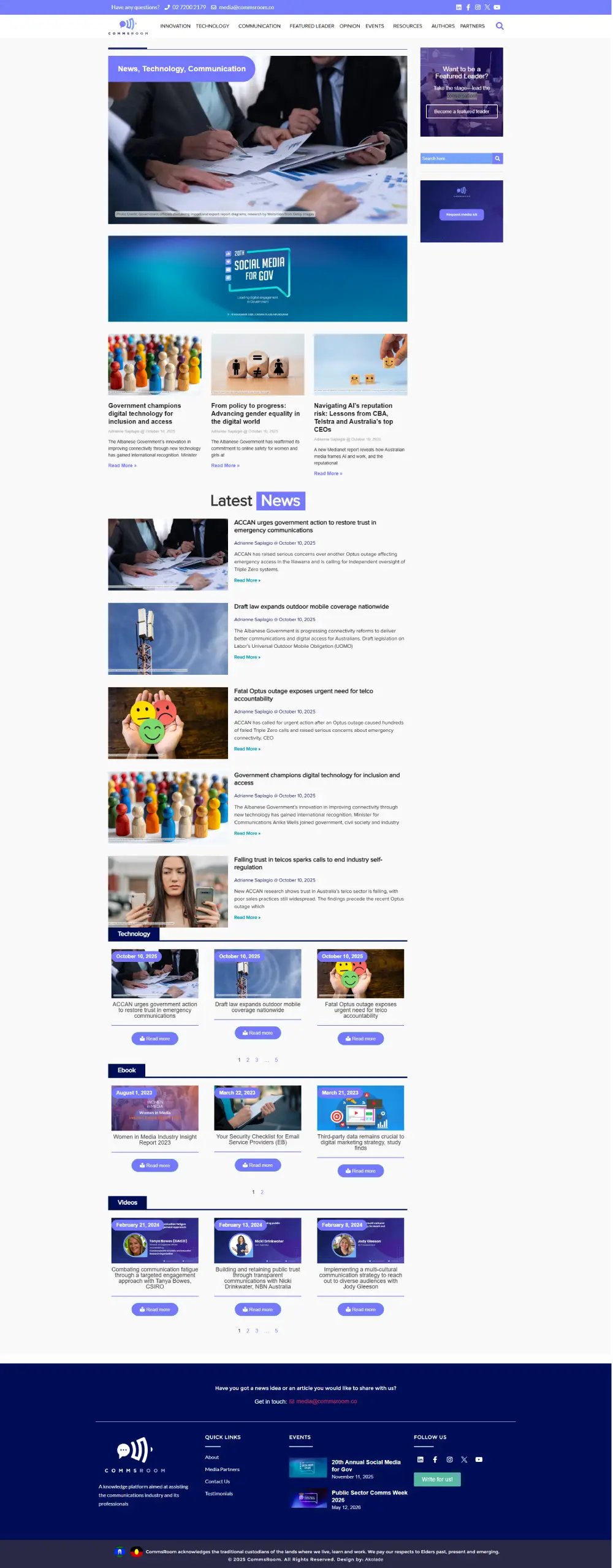
Comms Room, a leading communications newsletter website, wanted a modernized platform with a custom post type (CPT) setup to manage their daily articles and categorized content efficiently.
We developed a fully dynamic, user-friendly website that automates content organization, enhances navigation between topics, and supports high-volume publishing. The result is a sleek, modern platform that streamlines content management while elevating the reader experience — keeping Comms Room’s news delivery fast, engaging, and future-ready.