
Most businesses win some deals and lose others without knowing exactly why. Sales Process & Client Flow Improvement builds the structure, the stages, and the tracking that make revenue predictable — not accidental.
Sales & client flow problems come in two connected forms: inconsistent conversion that makes revenue unpredictable, and inconsistent client experience that limits retention and referrals. This engagement addresses both.
We build the stages, the documentation, and the accountability structure that make your sales process repeatable — and your client experience something clients actively recommend to others.
A structured, documented sales process — from initial contact to closed and onboarded — with clear stages, defined criteria for moving between them, and measurable conversion at every step.
The experience your clients have from first engagement through delivery and renewal — designed to be consistent, professional, and structured around the moments that drive retention and referrals.
The tools and cadence for tracking pipeline health, conversion performance, and revenue forecast — so you know where you stand and can make decisions based on data.

“The sales process that got you to where you are probably worked because of who was doing it, not because of how it was designed. Scaling requires separating those two things.”
A sales process that lives in one person’s head — or in the habits of a small founding team — cannot be delegated, measured, or improved. It also cannot survive when that person leaves, gets sick, or gets overwhelmed.
The same applies to client experience: when it depends on individual relationships rather than documented process, it doesn’t scale — and when it varies between clients or team members, it erodes trust in the brand.
No consistent deal flow means no ability to plan — headcount, investment, capacity, or cash.
One person closes well, another doesn't — a signal that the process isn't the common thread.
Interested prospects disappearing without a clear explanation — suggesting a gap in follow-up or proposal process.
Delivery is solid, but clients aren't staying or sending others — a signal that the experience isn't creating advocates.
No reliable pipeline visibility means every financial decision is a guess under uncertainty rather than a plan under clarity.
Each new client is a slightly different experience — depending on who's handling it and what was agreed during the sale.
Every engagement addresses the specific focus areas most relevant to the business. These are the six areas the engagement is built around.
Defining clear, specific stages that every deal moves through — with explicit entry and exit criteria at each stage, so pipeline position means the same thing to everyone on the team and can be tracked reliably.
Building a proposal structure that communicates value clearly, answers the questions prospects are actually asking, and gives your team a template they can follow consistently without sacrificing the ability to personalize.
Designing the follow-up process that keeps deals moving without pressure tactics — with defined timing, messaging frameworks, and escalation paths so nothing goes quiet without a deliberate decision to let it.
What the client journey looks like before this engagement — and what it’s designed to look like after.
Handled differently depending on who picks it up. No consistent response time or first-message structure.
Informal and variable. Questions asked depend on who’s running the meeting. No consistent qualifying criteria.
Recreated each time. Varies in format, content, and depth. No template or standard value framing.
Depends on whether someone remembers to do it. No defined timing or messaging sequence.
Improvised. Each client gets a different experience based on who’s managing it and how the sale went.
Passive. No structured check-ins, reviews, or renewal conversation process. Referrals happen by accident.
Documented response protocol. Consistent first-message structure. Clear criteria for when and how to engage.
Structured discovery framework. Consistent qualifying questions. Clear criteria for advancing or disqualifying.
Templated structure with personalization built in. Consistent value communication. Clear pricing and next steps.
Defined sequence with specific timing and messaging frameworks. Nothing goes quiet without a deliberate decision.
Documented onboarding process. Every client gets the same experience. Expectations set clearly from day one.
Structured check-in cadence. Defined renewal conversation process. Referral system built into the relationship.
Every Sales Process & Client Flow engagement produces documented, operational outputs — not a strategic recommendations deck. These are working tools your team can follow immediately.
Every stage in the sales process defined — with specific entry criteria, exit criteria, and the activities required at each stage. A working document your team can follow, train from, and measure against.
A structured proposal template designed around your specific offer — with the value framing, objection handling, and next-step design built in. Adaptable to each client, consistent in approach.
The defined follow-up cadence — timing, messaging structure, and escalation path — for every stage of the sales process. Nothing goes quiet without a deliberate decision.
A documented onboarding process that every new client moves through — from signed agreement to active engagement — with the communication, expectation-setting, and first-week structure defined clearly.
The structured touchpoints, review cadence, and referral conversation framework that turns satisfied clients into long-term clients and active referrers — built into the relationship, not left to chance.
The tracking infrastructure — tools configured, stages defined, review cadence designed — that gives you real visibility into pipeline health and a reliable basis for revenue forecasting.
Some months are strong, some are weak — and you’re not sure whether it’s the market, the effort, or something structural in the process.
Conversion is happening, but the pattern isn’t clear enough to replicate deliberately or improve systematically.
What works is intuitive rather than documented — which means it can’t be delegated, trained, or measured consistently.
Delivery is good but clients aren’t staying longer or sending others — suggesting the experience isn’t being managed as a deliberate growth driver.
Bringing on a sales hire without a documented process means they’ll create their own — which may or may not work, and you won’t know until it doesn’t.
Sales Process & Client Flow Improvement follows a structured sequence — from understanding the current state through to delivering the documented system your team can use immediately.
We review how your sales process actually works today — how leads move, how deals are managed, how proposals are structured, and what the client experience looks like from initial contact through delivery.
We identify where conversion is breaking down, where deals are stalling, and where the client experience is creating friction or failing to build the loyalty the business should be generating.
We design the sales stages, the proposal framework, the follow-up sequence, and the onboarding and retention processes — tailored specifically to your business model and client base.
We produce the working documents and configure the tracking tools — so the process exists in a form your team can follow, measure, and improve, not just in a presentation.
We walk you and your team through the new process and deliver the implementation plan — the sequence for transitioning from the old approach to the new one without disrupting active deals or clients.

Identify the specific constraints holding your revenue back — pipeline, conversion, pricing, or revenue leakage — and build a prioritized plan to remove them.

Build business infrastructure that scales — removing the operational friction that slows growth, drains capacity, and keeps you in the middle of everything.

Organize your financials and build the reporting framework that gives you a clear, reliable view of performance — so you know exactly where the business stands at any point.
Start with a conversation. We’ll review what you’re currently seeing in your pipeline and client flow, identify what’s creating the inconsistency, and tell you honestly whether this engagement is the right starting point.
No commitment. We’ll tell you what this engagement can and can’t do for your business.
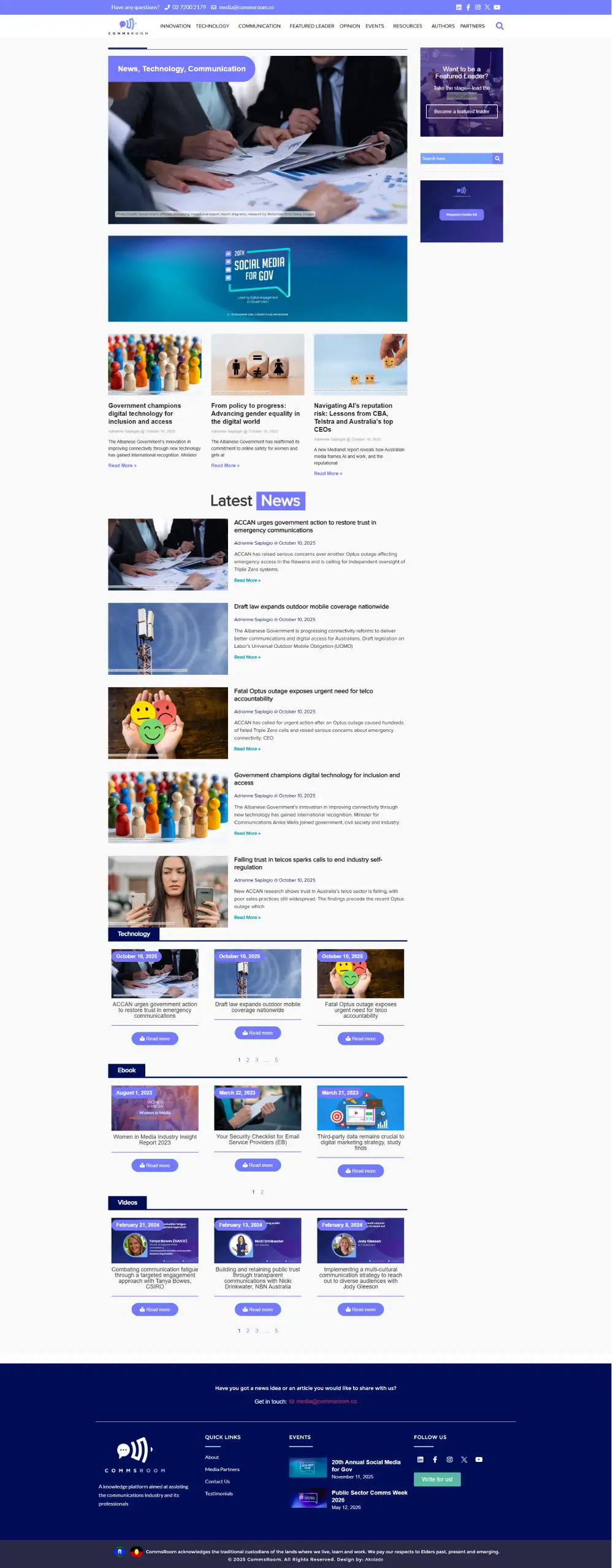
Comms Room, a leading communications newsletter website, wanted a modernized platform with a custom post type (CPT) setup to manage their daily articles and categorized content efficiently.
We developed a fully dynamic, user-friendly website that automates content organization, enhances navigation between topics, and supports high-volume publishing. The result is a sleek, modern platform that streamlines content management while elevating the reader experience — keeping Comms Room’s news delivery fast, engaging, and future-ready.