Most businesses reach a point where the systems they started with can no longer support the business they're becoming. Operational & Systems Optimization identifies the friction, redesigns the infrastructure, and builds the capacity to grow without constant firefighting.
WHAT THIS ADDRESSES
Operational friction that slows growth and drains team capacity
WHAT THIS PRODUCES
Systems built to scale without adding proportional overhead
Most operational problems aren't where you think they are. Businesses often push harder on growth while the real constraint is a quiet, structural gap in how the work actually gets done.
THE CORE ISSUE
When growth depends on individual effort, informal workarounds, and your team running harder every quarter, you don't have a scaling business — you have a capacity ceiling. This engagement replaces the workarounds with structure.
Map the actual state of your operations — where work is being done manually, informally, or inconsistently. Identify the specific friction points that slow delivery, reduce quality, or drain your team.
Redesign the systems, workflows, and tools that support how your business delivers value — built around your actual business model, not generic best practices borrowed from a different type of company.
Move from the current state to the designed state with a structured implementation plan — including documentation, team adoption, and accountability mechanisms that make the new system stick.
THE PATTERN WE SEE
Most businesses are built on a foundation of informal decisions, manual processes, and individual knowledge that isn't documented or transferable. This works — until it doesn't.
The moment you need to grow, hire, delegate, or take time away from the business, the gaps in the operational infrastructure become visible. And at that stage, growth stops looking like an opportunity and starts feeling like a threat.
SIGNAL 01
Different team members producing different results — a signal that the process doesn't exist yet, only individual habits and preferences.
SIGNAL 02
Onboarding takes too long because nothing is documented. Knowledge lives in people's heads, not in systems the business owns.
SIGNAL 03
Every exception, every edge case, every important decision still routes to the founder or senior leader — a structural constraint on how fast the business can move.
SIGNAL 04
Manual data entry, spreadsheet reconciliation, and tool-to-tool handoffs are consuming hours your team should spend on real work.
FOUR AREAS WE OPTIMIZE
AREA 01
Before anything can be optimized, it has to be documented. We map every core workflow in your business — how work actually moves from start to delivered — and identify where decisions are informal, steps are redundant, or handoffs are creating friction.
Process documentation: Every core workflow captured, step by step, in language your team can follow.
Friction identification: The specific steps that slow delivery, create rework, or require owner involvement to resolve.
Redesign recommendations: A structured redesign of the workflow with friction removed and decision ownership clarified.
AREA 02
Most businesses accumulate tools without architecture — each added to solve a specific problem, with no one responsible for making them work together. The result is data living in the wrong place, team members maintaining manual bridges, and no clear view of what's happening across the business.
Current stack review: Every tool your business currently uses — what it does, how it's used, whether it's actually needed.
Integration mapping: Where tools should connect but don't — and how to close the gap without manual workarounds.
Rationalization plan: Which tools to consolidate, replace, or retire — with a sequence for transitioning without disruption.
AREA 03
Growth requires that the owner step out of operations. Not by leaving — but by building the systems and role clarity that let decisions be made at the right level without constant escalation. This requires documenting what good looks like, defining who owns what, and building the accountability layer that makes delegation safe.
Role and ownership mapping: Clear accountability for every function — what each role owns and what decisions they can make independently.
Decision rights framework: A documented structure for which decisions require owner involvement and which don't.
Escalation design: When and how issues should surface to leadership — preventing both over-escalation and silent failures.
AREA 04
You can't manage what you can't see. Most businesses lack a consistent, reliable way to track operational performance — which means decisions about staffing, capacity, and delivery quality are being made on intuition instead of data. We design the measurement layer that gives you a real-time view of how the operation is performing.
KPI selection: The specific metrics that actually matter for your business model — not a generic list borrowed from another industry.
Reporting cadence design: How often to review what, and who needs which view of performance.
Early-warning indicators: Leading metrics that surface operational problems before they become delivery failures or client issues.
OUR APPROACH
Operational work only works when it's grounded in the actual business. These are the principles that shape how we work.
We map the current state before recommending any change. Generic operational advice applied without a clear understanding of how a specific business actually works almost always creates new problems rather than solving old ones.
Complex systems require complex people to run them. We design for the simplest version that reliably produces the required outcome — because simple systems are the ones teams actually follow.
A new process that the team doesn't follow has no value. We design adoption into every change — with documentation, training, and accountability structures that make the new system the path of least resistance.
We design systems for where you're going, not just where you are. The operational infrastructure we build is intended to support the business at 2× its current scale — so you're not rebuilding everything again in 18 months.
WHAT YOU RECEIVE
Every Operational & Systems Optimization engagement produces concrete, documented outputs — not a consulting report that sits on a shelf.
Start the Engagement →Every core workflow documented step by step — in formats your team can follow without needing to interpret or remember anything. This belongs to you, and your team can maintain it.
A complete review of your current tools — what to keep, what to replace, what to retire, and the sequence for making changes without disrupting ongoing operations.
A documented structure defining who owns what, what decisions each role can make independently, and how exceptions surface to leadership — so the team can operate without constant owner involvement.
The specific metrics that matter for your business, how to track them, what cadence to review them on, and what each metric is intended to tell you about how the operation is performing.
A sequenced plan for moving from the current state to the designed state — which changes to make first, what each change requires, and how to phase implementation without disrupting the business in operation.
IS THIS RIGHT FOR YOU?
Operational & Systems Optimization is designed for businesses that are succeeding — but whose internal systems were built for a smaller, simpler version of the business they've become.
If you recognize your situation in any of these, this engagement is the right starting point.
Schedule a Conversation →Revenue is growing but so is the time and energy required to deliver — the systems aren't compounding yet, they're constraining.
The quality of what you deliver varies — by team member, by project, by week — in ways you can't fully explain or control.
Taking time away means things fall through — because too much depends on you personally, not on documented systems the team can follow.
Talented people doing manual work, maintaining workarounds, or spending time on tasks that a well-designed system should handle automatically.
Growth is coming — and you want the operational foundation in place before adding headcount or taking on more complexity.
MORE SERVICES
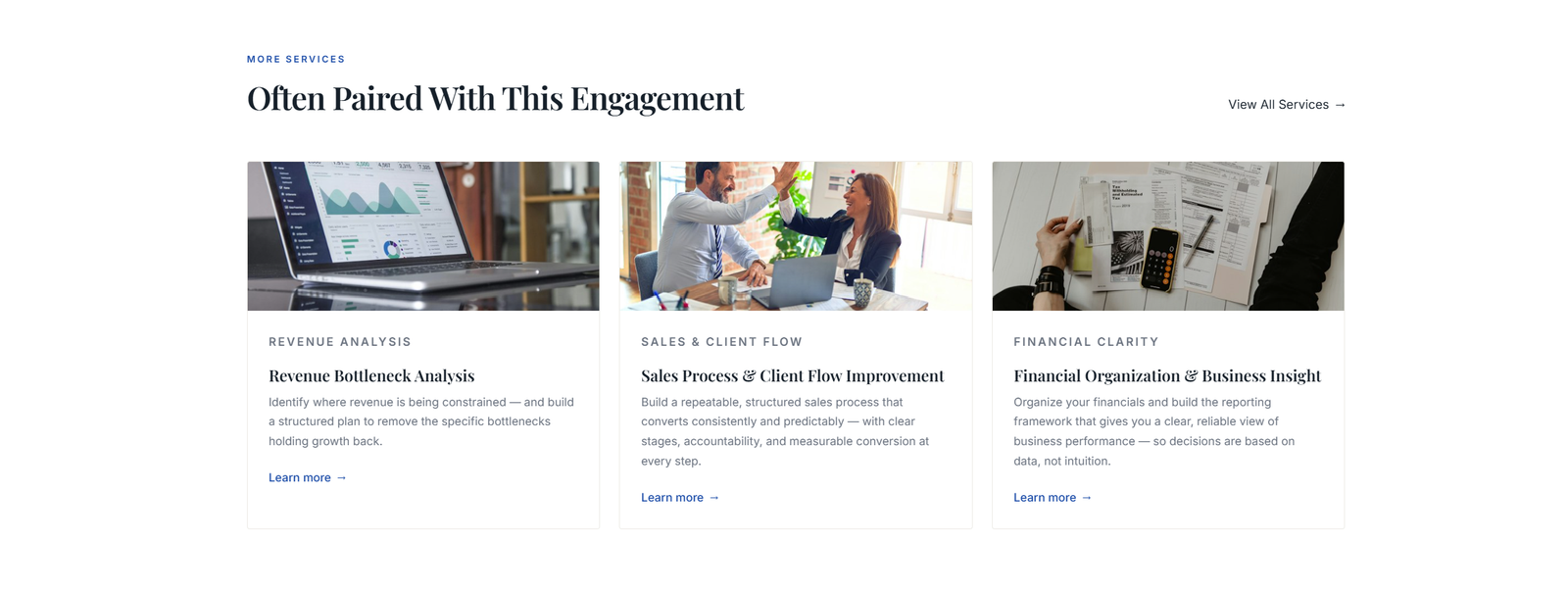
REVENUE ANALYSIS
Identify where revenue is being constrained — and build a structured plan to remove the specific bottlenecks holding growth back.
Learn more →
SALES & CLIENT FLOW
Build a repeatable, structured sales process that converts consistently and predictably — with clear stages, accountability, and measurable conversion at every step.
Learn more →
FINANCIAL CLARITY
Organize your financials and build the reporting framework that gives you a clear, reliable view of business performance — so decisions are based on data, not intuition.
Learn more →HOW IT WORKS
Operational & Systems Optimization follows a structured sequence — from understanding the current state to implementing a designed future state.
We understand your business model, team structure, and the specific operational challenges that brought you here. This scopes the engagement to the areas where change will have the greatest impact.
We document how the business actually operates today — every core workflow, every tool, every decision that currently requires owner involvement. This is the diagnostic foundation everything else builds on.
We identify exactly where the current systems break down — the specific bottlenecks, manual workarounds, and structural gaps that are limiting the business's capacity and consistency.
We design the future state — redesigned workflows, rationalized tools, accountability frameworks, and performance tracking infrastructure, built specifically for your business model.
We deliver the prioritized plan for moving from current to future state — sequenced so you can implement without disrupting operations, with clear milestones and accountability built in.
GET STARTED
Begin with a conversation. We'll review what you're seeing, identify which operational constraints are holding the business back, and tell you honestly what this engagement can produce for you.