
Artificial intelligence is no longer simply an emerging technology. It is becoming an increasingly important part of how businesses operate, make decisions, serve customers, and compete.
From marketing automation and predictive analytics to AI-powered customer service and intelligent business processes, organizations have more opportunities than ever to incorporate AI into their operations.
But there is an important distinction between adopting AI and gaining an AI advantage.
Many businesses are experimenting with AI tools. Far fewer have developed a clear strategy for turning those tools into measurable improvements in revenue, efficiency, customer experience, or long-term competitiveness.
The difference comes down to strategy.
AI should not be implemented simply because it is popular or because competitors are using it. The most successful organizations approach AI as a business transformation opportunity—one that connects technology with specific objectives and measurable outcomes.
Here is how businesses can make that transition.

AI adoption means introducing artificial intelligence into some part of the organization.
AI advantage goes further.
It means using AI intentionally to create an improvement that matters to the business.
For example, a company might introduce an AI writing tool to help its marketing team create content faster. That’s AI adoption.
But if the company redesigns its content workflow, uses AI to analyze customer interests, personalizes campaigns, improves lead qualification, and measures the resulting increase in qualified opportunities, it is moving toward an AI advantage.
The technology itself is not the advantage.
The advantage comes from how the organization applies it.
The advantage comes from how the organization applies it.
NOVA CAPITAL CONSULTING
One of the biggest mistakes businesses make is starting with technology instead of the problem.
Instead of asking:
“Where can we use AI?”
Businesses should ask:
“Where are we experiencing a problem that AI could help solve?”
The strongest opportunities are often found in processes that are:
For example, a professional services company might identify opportunities in proposal development, research, reporting, client communication, or internal knowledge management.
A marketing organization might identify opportunities in customer segmentation, campaign analysis, content production, lead qualification, or personalization.
The objective isn’t to introduce AI everywhere.
It is to identify the highest-value opportunities first.
Starting with focused initiatives also allows organizations to demonstrate value quickly, build internal confidence, and establish a foundation for larger transformation projects.
AI initiatives become significantly more valuable when they are connected directly to business objectives.
A business shouldn’t measure success simply by asking how many employees are using AI.
Instead, leadership should ask:
This changes the conversation from technology adoption to business performance.
For example, suppose a company wants to increase qualified leads.
AI could potentially support:
Customer research → audience segmentation → personalized content → lead scoring → sales prioritization → performance analysis
The important point is that AI is being used as part of a larger growth strategy rather than as an isolated tool.
AI becomes even more powerful when it connects multiple parts of the organization.
Marketing is one of the clearest examples.
AI can support many stages of the customer journey, including:
The final step—and one that is frequently overlooked—is measurement.
An AI initiative should have a clear definition of success before it is scaled.
Depending on the project, businesses may track metrics such as:
These measurements create a feedback loop.
Implement → Measure → Learn → Optimize → Scale
If an initiative produces meaningful results, the organization can expand it.
If the results aren’t strong enough, leadership can adjust the workflow, improve the data, change the technology, or reconsider the business case.
This approach reduces the risk of investing heavily in AI initiatives that don’t produce meaningful value.
AI can help organizations analyze customer feedback, market information, search behavior, and other available data to identify patterns and opportunities.
Marketing teams can use AI to accelerate research, ideation, drafting, content repurposing, and campaign development while maintaining appropriate human review.
Instead of delivering the same message to every customer, organizations can use data and AI-enabled systems to create more relevant experiences for different audiences.
AI can help analyze campaign performance and identify patterns that may otherwise take significant amounts of manual effort to uncover.
AI-enabled workflows can help organize and prioritize leads so sales teams can focus their attention where it is most valuable.
AI can support faster responses, better information retrieval, and more personalized interactions across customer touchpoints.The same principle applies to business operations.

AI transformation isn’t only a technology challenge.
It is a business strategy challenge.
Organizations must consider technology, people, processes, data, governance, customer experience, risk, and organizational change at the same time.
This is where experienced consulting guidance can make a significant difference.
A strategic consulting partner can help an organization:
Without a clear roadmap, organizations can end up with disconnected AI experiments that never become part of the broader business strategy.
With the right framework, individual AI initiatives can become components of a much larger transformation.
Marketing is likely to remain one of the areas where AI creates significant opportunities.
The next phase isn’t simply about producing more content faster.
It is about creating more intelligent customer experiences.
Businesses are increasingly looking toward AI to help them understand customers, anticipate needs, personalize communication, analyze performance, and improve the effectiveness of their marketing investments.
This creates an important shift for marketing leaders.
The question is no longer:
“How much content can AI create?”
Instead, the more strategic question is:
“How can AI help us understand and serve our customers better?”
That distinction matters.
More content does not automatically create more growth.
Better insights, stronger positioning, relevant experiences, and effective execution are what ultimately create business value.
Better insights, stronger positioning, relevant experiences, and effective execution are what ultimately create business value.
NOVA CAPITAL CONSULTING
Technology alone cannot create sustainable transformation.
Organizations also need the right foundation.
An AI-ready business should consider:
AI is only as useful as the information and processes supporting it. Organizations should evaluate data quality, accessibility, security, and governance.
Employees need to understand how AI changes their workflows and how they can use these technologies effectively.
Existing processes may need to be redesigned rather than simply automated.
Executives need to establish priorities and ensure AI initiatives support the organization’s strategic direction.
Businesses should establish appropriate policies around privacy, security, accuracy, oversight, and responsible AI use.
Successful AI transformation requires a culture that encourages experimentation while maintaining accountability.
This is why AI transformation should be treated as an organizational initiative—not simply an IT project.

Organizations that approach AI strategically have an opportunity to improve how they compete.
They can potentially:
But competitive advantage doesn’t come from having access to the same AI tools as everyone else.
Most organizations can access similar technologies.
The differentiator is how effectively those technologies are integrated into the business.
A company that understands its customers better, executes faster, measures results more effectively, and continuously improves its processes can create an advantage that is much harder for competitors to replicate.
The differentiator is how effectively those technologies are integrated into the business.
NOVA CAPITAL CONSULTING
AI adoption will continue to accelerate.
But adoption alone will not determine which organizations succeed.
The organizations that create lasting value will be those that connect AI with strategy, people, processes, data, marketing, and measurable business outcomes.
The opportunity isn’t simply to use artificial intelligence.
It is to rethink how the organization works—and determine where AI can create meaningful improvements.
For business leaders, the next step should not necessarily be buying another AI tool.
It should be developing a clear answer to three questions:
Where can AI create the greatest value?
How will we implement it responsibly?
How will we measure whether it actually worked?
Those answers provide the foundation for moving from AI experimentation to AI advantage.
Artificial intelligence has the potential to transform businesses—but meaningful transformation requires more than technology.
At Nova Capital Consulting, we help organizations evaluate opportunities, develop strategic roadmaps, improve operations, and identify practical ways to turn emerging technologies into measurable business value.
The goal isn’t simply to adopt AI.
The goal is to make AI work for your business.
Ready to explore what’s possible? Connect with Nova Capital Consulting to begin building your AI-driven growth strategy.
The future of financial services is being shaped by digital innovation, evolving markets, and new forms of value. We help financial institutions, fintechs, and digital asset businesses turn change into opportunity and build for sustainable growth.
Ideas that drive better


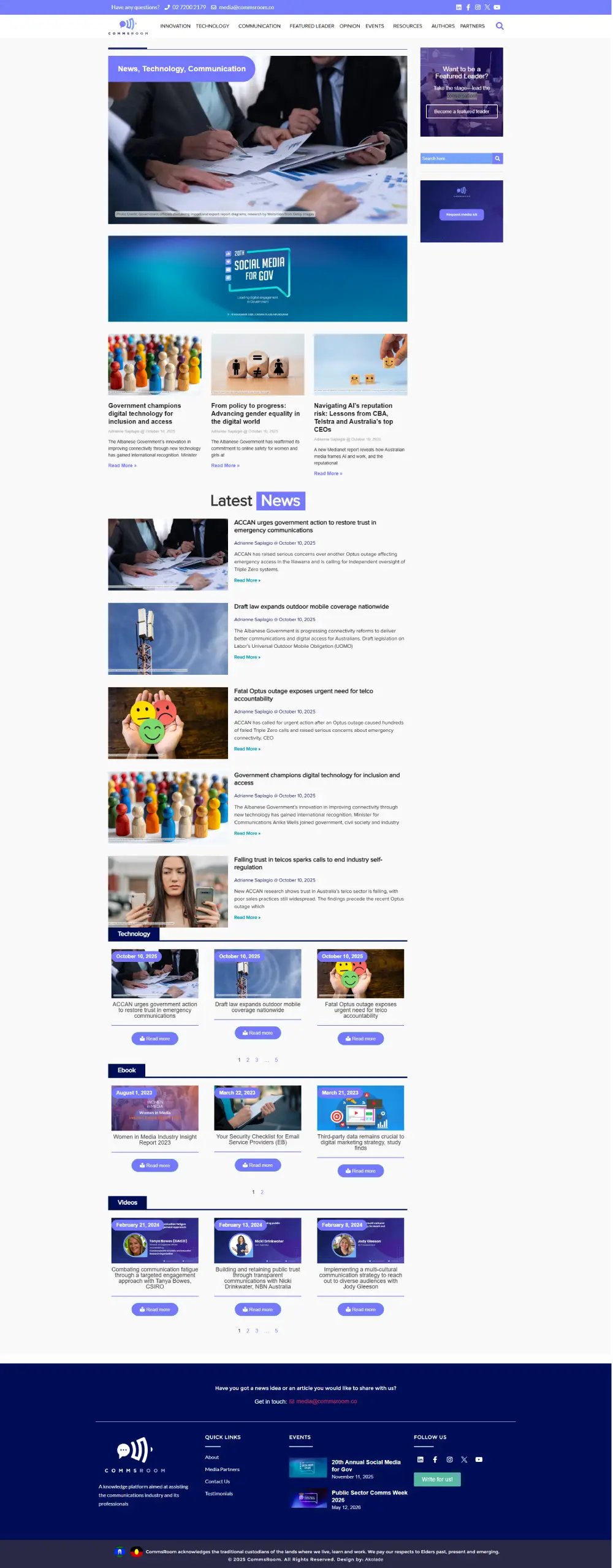
Comms Room, a leading communications newsletter website, wanted a modernized platform with a custom post type (CPT) setup to manage their daily articles and categorized content efficiently.
We developed a fully dynamic, user-friendly website that automates content organization, enhances navigation between topics, and supports high-volume publishing. The result is a sleek, modern platform that streamlines content management while elevating the reader experience — keeping Comms Room’s news delivery fast, engaging, and future-ready.