
In today’s digital economy, organizations generate more data than ever before. From customer interactions and financial transactions to operational metrics and market insights, businesses have access to an unprecedented volume of information. Yet many organizations continue to make critical decisions based on assumptions, intuition, or incomplete information.
A data-driven decision-making framework enables organizations to transform raw data into actionable insights that improve business performance, reduce uncertainty, and accelerate growth.
Companies that embed data into their decision-making processes consistently outperform competitors by making faster, smarter, and more confident business decisions.

Every business decision carries a degree of uncertainty. A structured decision-making framework minimizes uncertainty by providing objective evidence to support business choices. Organizations that effectively use data gain several strategic advantages:
Rather than reacting to problems after they occur, businesses become proactive by identifying patterns and opportunities early.
Despite significant investments in analytics and business intelligence tools, many organizations struggle to become truly data-driven. Common obstacles include:
Business information often exists across multiple systems such as CRM platforms, ERP software, accounting systems, marketing tools, and operational databases. Without integration, leaders struggle to gain a complete view of organizational performance.
Incomplete, outdated, duplicated, or inconsistent data can produce misleading insights. Reliable decision-making begins with accurate and trustworthy information.
Modern businesses collect enormous amounts of data, but not every metric supports strategic decisions. Leaders often spend too much time reviewing reports that offer little actionable value.
Traditional reporting processes may require days or even weeks to generate insights. By the time reports reach executives, market conditions may have already changed.
Employees may have access to dashboards but lack the knowledge to interpret trends, identify meaningful patterns, or translate insights into business actions.
Many organizations continue relying on experience and hierarchy instead of objective evidence. Building a data-driven culture requires leadership commitment and organizational change.

Successful organizations follow a structured framework that transforms information into measurable business outcomes.
Data-driven organizations treat decision-making as an ongoing process rather than a one-time event.
Nova Capital Consulting
Technology alone does not create data-driven organizations. Sustainable success requires building a culture where employees at every level understand the value of evidence-based decision making. Organizations can foster this culture by:
When employees trust and use data consistently, decision quality improves throughout the organization.
Artificial Intelligence is transforming how organizations analyze and utilize business information. AI-powered analytics solutions can:

Rather than replacing leadership, AI enhances executive decision-making by delivering faster insights and enabling leaders to focus on strategic priorities.
Organizations that implement a structured decision-making framework often achieve measurable improvements across multiple areas.
Real-time dashboards and automated reporting allow leaders to respond quickly to changing business conditions.
Evidence-based investment decisions improve profitability and reduce unnecessary expenditures.
Analyzing customer behavior enables organizations to deliver personalized experiences and improve retention.
Performance metrics reveal bottlenecks, eliminate waste, and streamline business processes.
Predictive analytics helps organizations identify potential challenges before they become significant issues.
Businesses that leverage data effectively respond more quickly to market opportunities than competitors relying on intuition alone.
Organizations beginning their data-driven transformation should consider the following roadmap:
Implementing these steps creates a strong foundation for sustainable business intelligence and long-term strategic success.
In an increasingly competitive and technology-driven marketplace, organizations can no longer rely solely on intuition or historical experience to guide strategic decisions. Businesses that consistently leverage accurate, timely, and meaningful data are better equipped to navigate uncertainty, uncover growth opportunities, and deliver superior customer value.
A robust data-driven decision-making framework empowers leaders with the confidence to make informed choices backed by evidence rather than assumptions — data becomes more than information, it becomes a strategic asset that drives innovation, resilience, and sustainable growth.
Nova Capital Consulting
At Nova Capital Consulting, we help organizations build data-driven capabilities that transform information into actionable business intelligence, enabling executives to make smarter decisions, improve performance, and achieve lasting competitive advantage.
Ideas that drive better


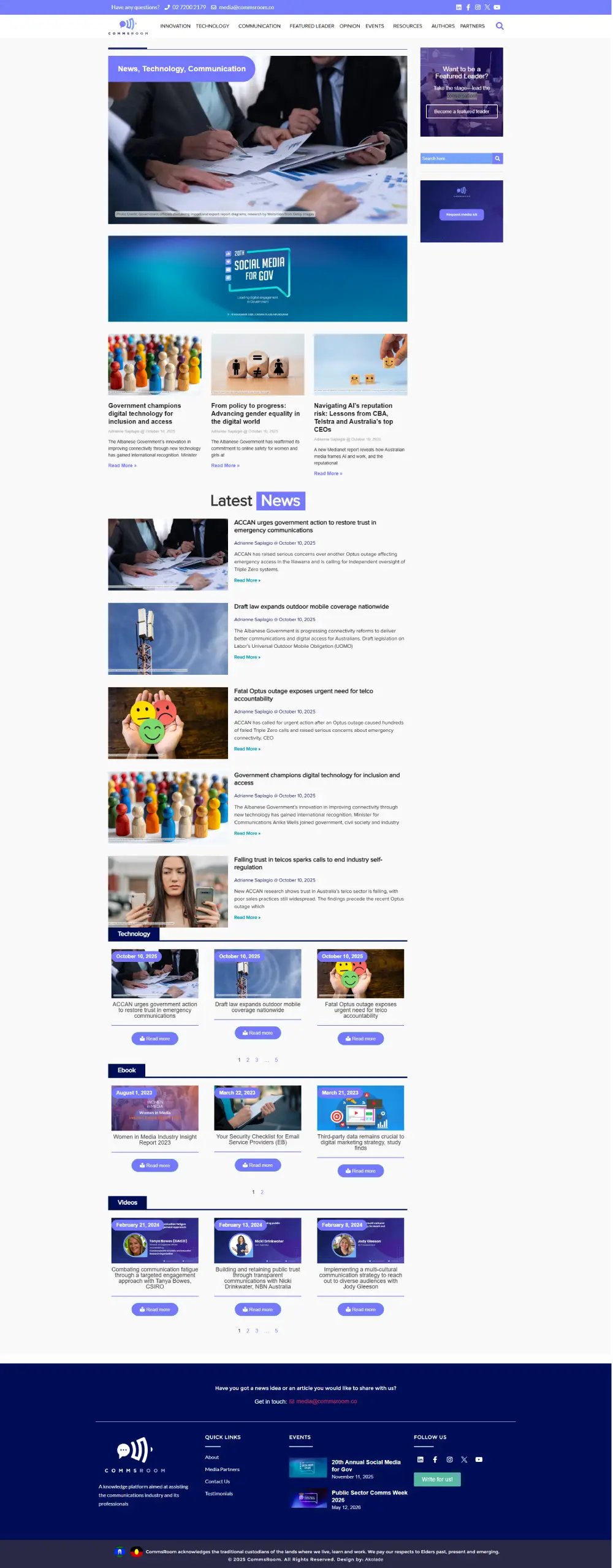
Comms Room, a leading communications newsletter website, wanted a modernized platform with a custom post type (CPT) setup to manage their daily articles and categorized content efficiently.
We developed a fully dynamic, user-friendly website that automates content organization, enhances navigation between topics, and supports high-volume publishing. The result is a sleek, modern platform that streamlines content management while elevating the reader experience — keeping Comms Room’s news delivery fast, engaging, and future-ready.