Application Support and Modernization
Every application accumulates complexity over time. What started as a solution can become a constraint. We advise organizations on how to assess, support, and modernize the applications their business depends on.
Start a ConversationThe Strategic Decision
The most consequential technology decisions many organizations face is not what to build — it’s what to do with what they already have. Legacy systems and aging applications represent significant investment, operational risk, and a constant demand for resources.
The right answer is never obvious. An application can look outdated but be performing critical functions reliably. A more modern-looking option can be carrying unseen technical debt. The advisory work we do in this area starts with an honest assessment of what an organization actually has — before recommending what to do with it.
Common Scenarios
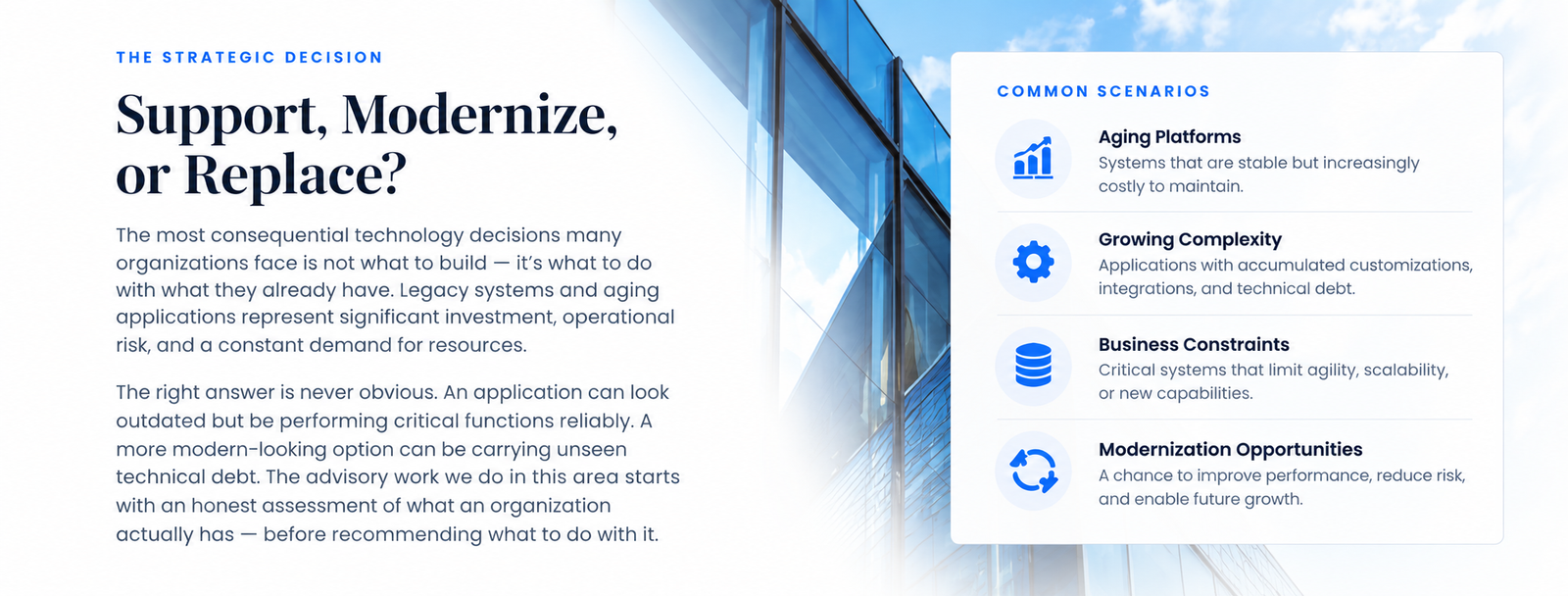
Systems that are stable but increasingly costly to maintain.
Applications with accumulated customizations, integrations, and technical debt.
Critical systems that limit agility, scalability, or new capabilities.
A chance to improve performance, reduce risk, and enable future growth.
Advisory Scope
Our advisory in this area addresses two distinct but often connected needs — structured support for applications in production and modernization planning for applications that need to change.
Track 01
For organizations that need to optimize application performance, reliability, and cost — particularly when the support model requires a strategic re-evaluation.
✓
Support structure and team design
✓
Incident and escalation process definition
✓
Documentation and knowledge management
✓
Technical debt assessment and prioritization
✓
Vendor and contract evaluation
✓
Transition planning when support arrangements change
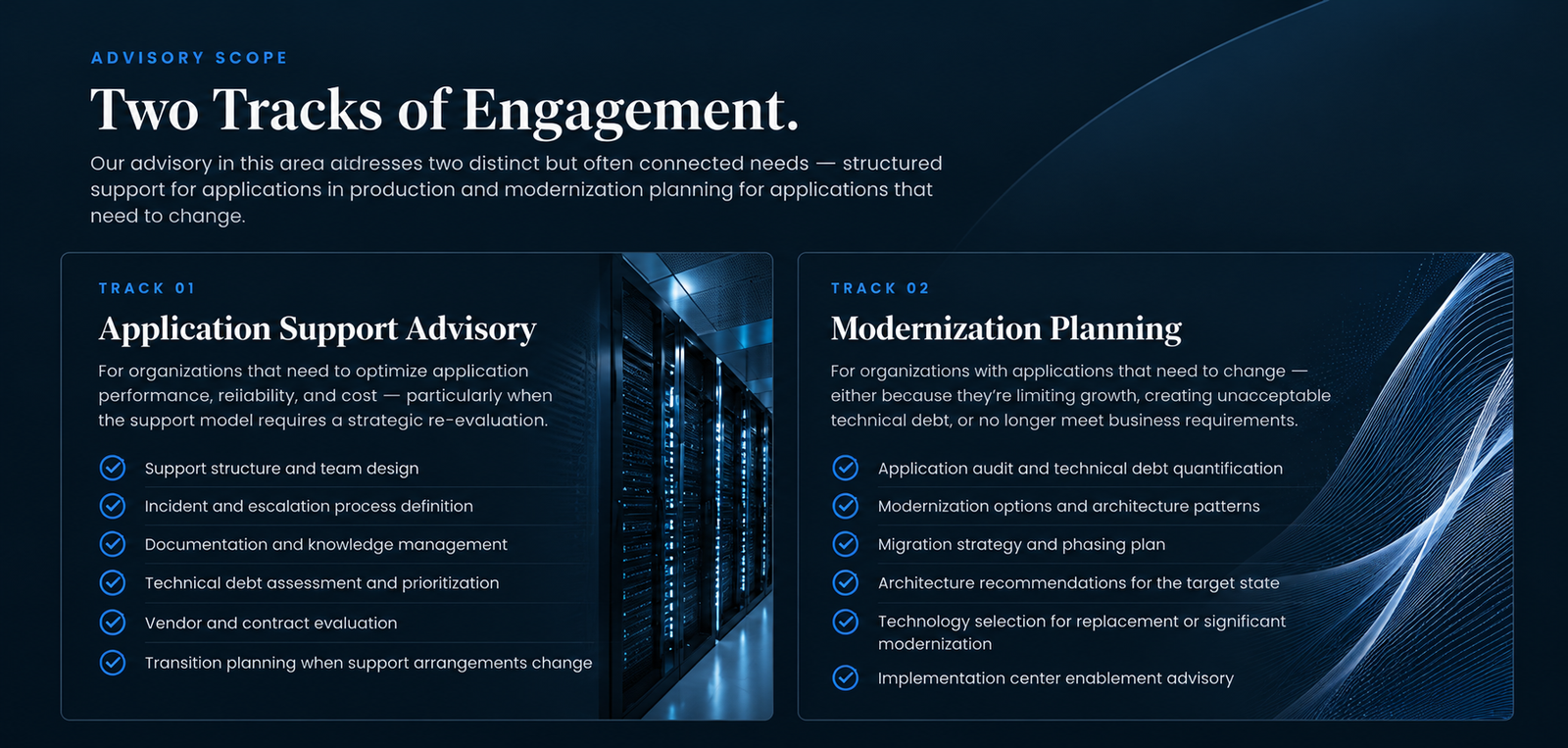
Track 02
For organizations with applications that need to change — either because they’re limiting growth, creating unacceptable technical debt, or no longer meet business requirements.
✓
Application audit and technical debt quantification
✓
Modernization options and architecture patterns
✓
Migration strategy and phasing plan
✓
Architecture recommendations for the target state
✓
Technology selection for replacement or significant modernization
✓
Implementation center enablement advisory
Potential Deliverables
Specific deliverables are scoped in each engagement. The following represents the types of outputs associated with this advisory service.
Stakeholder Note: This service description is a proposed framework subject to change. Integration advisory is not a managed service and does not include development or ongoing support. Deliverables will be tailored to your specific business context, objectives, and constraints.
01
Assessment of the application’s current state — architecture, technical debt, support model, and constraints.
02
Advisory on the appropriate support structure for the application.
03
Documented inventory of known technical debt items, prioritized by business impact and remediation complexity.
04
Evaluation of feasible modernization paths and recommendations.
05
Advisory on how to structure the transition from the current to the target state.
06
Ongoing advisory during modernization execution — technical reviews, scope management, and stakeholder support.
Key Considerations
No modernization recommendation is credible without an accurate picture of the existing application. We start with a structured audit — not a technology preference — before advising on direction. A recommendation made without this step is guesswork.
Organizations can’t afford modernization programs that disrupt the operations that depend on the application being modernized. Migration planning and phasing exist to protect continuity — they’re not optional parts of the advisory engagement.
The default recommendation in this space leans toward replacement. That recommendation is often wrong. A well-structured application running on an aging platform may benefit from re-platforming, not replacement. Our advisory is not biased toward any particular path.
We don’t hold partnership, referral, or reseller relationships with software or platform vendors. Technology selection advice reflects what fits the organization’s situation — not what benefits an existing vendor relationship.
Legacy applications often encode years of accumulated business logic that isn’t well-documented anywhere else. Modernization planning must account for what the application actually does — not just how it’s built — before anything changes.
A support arrangement without governance structure is a liability — unclear responsibilities, untested escalation paths, and undocumented systems create risk. The support advisory work addresses governance as a first-order concern.
Related Services
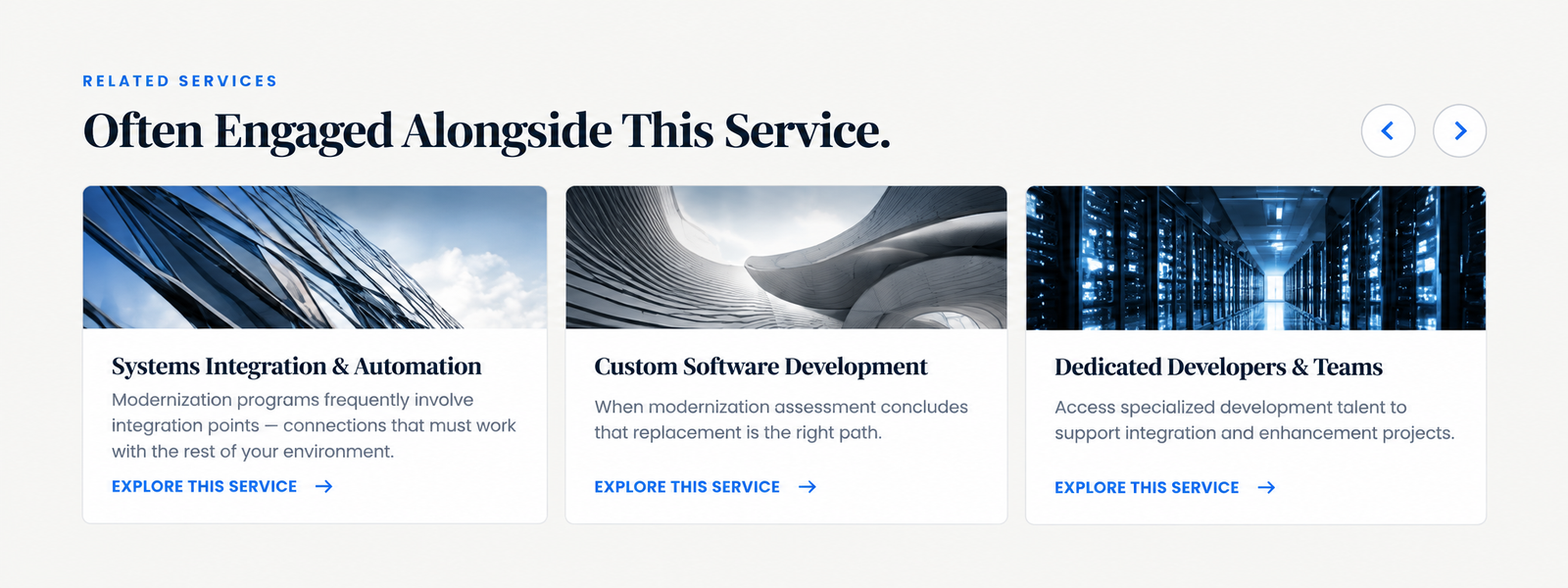
Modernization programs frequently involve integration points — connections that must work with the rest of your environment.
When modernization assessment concludes that replacement is the right path.
Access specialized development talent to support integration and enhancement projects.
The right decision about your application starts with an honest assessment. Let’s begin there.