
A regional multi-line insurance carrier came to Nova Capital Consulting with a problem that was showing up everywhere except the P&L reports leadership were used to reading: policyholders were renewing less, complaint volume was climbing after every claims cycle, and contact center wait times were becoming a running joke among frontline staff. The symptoms looked like a service problem. The root cause was structural — a customer experience model built for a slower, single-channel era, straining under multichannel volume it was never designed to absorb.
Over a two-quarter engagement, Nova Capital Consulting rebuilt the carrier’s service operating model from the point of first contact through claims resolution and renewal. The result: a 38% reduction in policyholder churn, a 46-point increase in Net Promoter Score, and 64% faster case resolution times — turning a source of recurring complaints into the carrier’s strongest retention lever.
The carrier’s service infrastructure had grown the way most do — one channel at a time. Phone support was added first, then email, then a chat widget, then a mobile app claims portal. Each channel performed reasonably well in isolation. But policyholders didn’t experience them in isolation. A claim opened by phone often had to be re-explained in chat, re-explained again to an adjuster, and re-explained a third time if it escalated. Nothing was lost by design; it was lost by handoff.

This is a pattern that shows up broadly in service-driven industries. PwC’s “Experience is Everything” research found that even loyal, high-value customers will walk away after a small number of poor experiences — meaning fragmentation doesn’t just annoy customers, it actively erodes the accounts a business can least afford to lose. In the carrier’s case, first-contact resolution had drifted so low that most claims required contact across at least two channels before they were considered closed, and each additional touch measurably increased the odds of non-renewal at the customer’s next policy cycle.
Every channel switch a customer makes is a small vote of no confidence in the business's ability to solve their problem.
Customer Experience Strategy

Leadership had been treating complaint volume as the metric to manage — adding headcount, scripting more empathetic call openings, tightening SLAs on response time. None of it addressed why the same policyholders kept re-contacting. Diagnostic work showed the real driver was ownership: no single role or system was accountable for a claim from intake to close, so issues stalled in the gaps between departments rather than in any one team’s queue.
The carrier also lacked a clear internal view of what churn from poor service actually cost. Acquisition spend was tracked closely; the economics of losing an existing policyholder to a bad claims experience were not. Once modeled, it became clear that even modest improvements in resolution speed and consistency would return more to the bottom line than any plausible increase in new-customer acquisition — reframing the engagement from a “service fix” to a retention investment with a measurable return.
Key improvements included:
The diagnostic phase reframed the challenge for leadership: this wasn’t a call-volume problem to staff around, it was a structural gap in ownership and visibility that would keep resurfacing under any channel mix until it was addressed directly.
With the economics and root causes established, Nova Capital Consulting moved from assessment into a phased redesign of the service operating model itself — starting with how a case is owned, not just how fast it is answered.
Nova Capital Consulting’s approach started from a simple reframe: the unit of work should be the customer’s issue, not the channel it arrived on. Every subsequent design decision — staffing, technology, escalation rules, incentives — was built to support that single case record from first contact to resolution, regardless of how many channels a policyholder touched along the way.

The team consolidated phone, chat, email, and the mobile claims portal onto a shared case record, so a policyholder’s history and open issue followed them automatically between channels instead of resetting at each handoff. This aligns with what Qualtrics’ Omnichannel CX Benchmark research identifies as a defining gap between service leaders and laggards: it’s not the number of channels a company offers, but whether those channels share context, that determines whether customers feel heard or repeat themselves.
Nova Capital Consulting redesigned the claims workflow around named case owners — a single adjuster or specialist accountable for a claim from open to close, with authority to resolve routine issues without escalation. This replaced a queue-based model where a case could pass through several hands with no one ultimately responsible for the outcome the policyholder experienced.

The team retired first-response-time as the primary service KPI and replaced it with a resolution-based scorecard: time to close, contacts-per-case, and reopen rate. This changed frontline incentives immediately — staff were no longer rewarded for answering quickly and closing early, but for solving the issue in as few touches as possible.
A service model that rewards speed over resolution will always produce fast answers to problems that aren't actually fixed.
Service Operations Transformation
Finally, Nova Capital Consulting built a structured feedback loop from post-resolution surveys directly back to case owners and team leads, rather than into a quarterly report no one acted on. This mirrors a pattern Zendesk’s customer service research highlights repeatedly: customers rarely expect perfection, but they consistently disengage from companies that don’t appear to act on the feedback they give — so the fastest trust-building move is often simply closing the loop.
Within two quarters of the redesigned service model going live, the shift was visible in both the customer-facing metrics and the operational ones behind them. Policyholders were resolving issues faster, in fewer touches, and were staying at renewal at meaningfully higher rates than before the engagement began.

NPS moved by 46 points over the engagement — a shift large enough to reclassify the carrier’s service experience from a competitive weakness to a differentiator. This tracks with the underlying logic behind NPS as a metric: as Frederick Reichheld’s foundational Harvard Business Review research established, promoter and detractor behavior is a leading indicator of referral and renewal behavior, not a lagging satisfaction score — meaning the carrier’s NPS gain was already showing up in its retention numbers before the full renewal cycle had even completed.
Average case resolution time dropped by 64%, driven almost entirely by the shift to named case ownership and shared context across channels. Contacts-per-case fell in parallel, meaning the speed gain didn’t come from rushing cases closed — it came from removing the re-explanation and hand-off delays that had been inflating resolution time in the first place.

Policyholder churn fell 38% year-over-year following the transformation, concentrated most heavily among customers who had filed a claim in the prior twelve months — the exact segment the old model was losing fastest. The case-ownership and shared-context model built for this engagement is now a reusable capability for the carrier, applied to new product lines without a rebuild.
Perhaps the most durable outcome was internal: the carrier now has a working retention-economics model connecting service investment directly to renewal revenue, giving leadership a defensible basis to fund future CX initiatives rather than treating them as a cost center to be trimmed in lean quarters.
The carrier’s results reflect a broader shift already underway across service-driven industries: experience is no longer a soft differentiator sitting alongside price and product, it is increasingly the deciding factor in whether a customer stays. As Zendesk’s 2025 CX Trends Report notes, organizations that unify service context and act on customer feedback are pulling ahead of competitors still treating each channel and each complaint as an isolated event. For Nova Capital Consulting’s client, that shift is no longer aspirational — it’s built into how service is run every day.
The future of financial services is being shaped by digital innovation, evolving markets, and new forms of value. We help financial institutions, fintechs, and digital asset businesses turn change into opportunity and build for sustainable growth.
Ideas that drive better

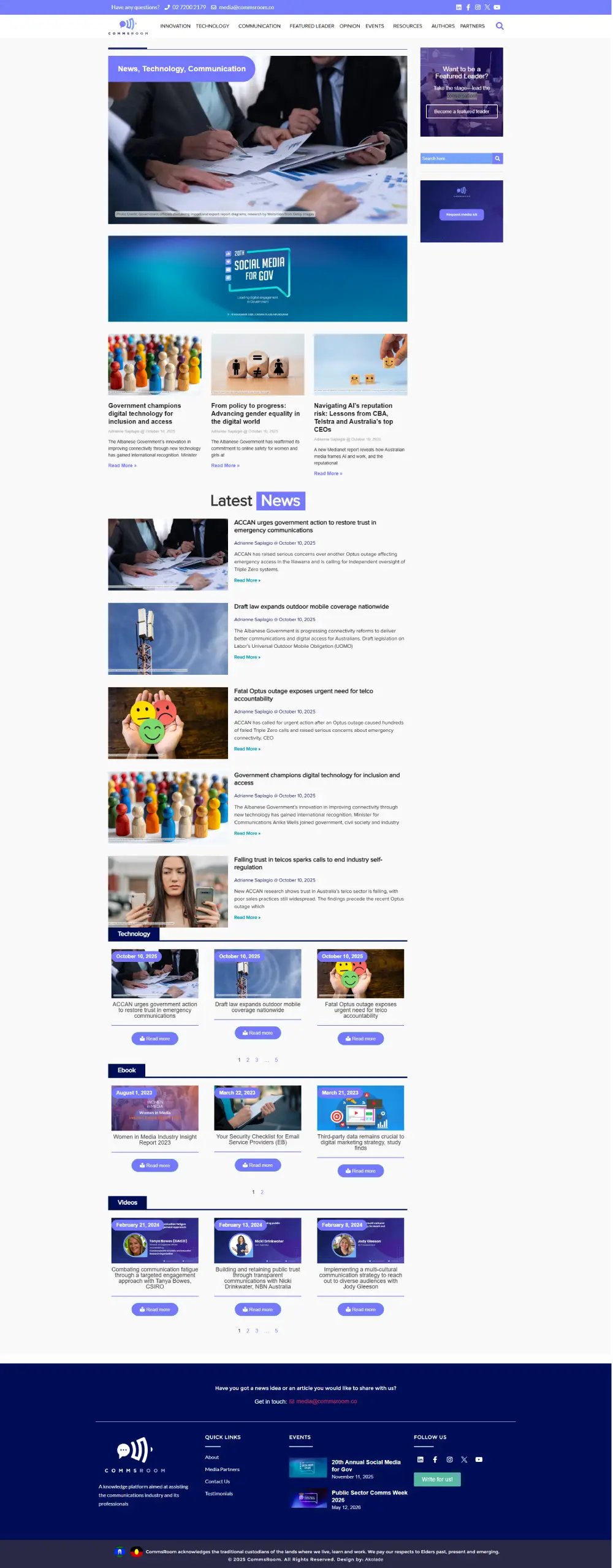
Comms Room, a leading communications newsletter website, wanted a modernized platform with a custom post type (CPT) setup to manage their daily articles and categorized content efficiently.
We developed a fully dynamic, user-friendly website that automates content organization, enhances navigation between topics, and supports high-volume publishing. The result is a sleek, modern platform that streamlines content management while elevating the reader experience — keeping Comms Room’s news delivery fast, engaging, and future-ready.