
Digitally mature companies are three times more likely to significantly outperform their industry peers on core financial metrics, yet for most small and mid-size enterprises, that level of maturity remains out of reach. A traditional, family-run distribution business had built three decades of success on paper order forms, phone-based sales, and a single on-premise accounting system that hadn’t been upgraded in over a decade. Its owners knew the business was losing ground to more agile, digitally-enabled competitors, but lacked the internal expertise, budget discipline, and change-management capacity to modernize without disrupting day-to-day operations.
Within twelve months, the engagement delivered a 34% increase in overall revenue, a 68% reduction in manual order-processing and invoicing time, and a threefold increase in online sales channel revenue.
The business had thrived for nearly 30 years on strong customer relationships and word-of-mouth reputation. But that success was built almost entirely on manual, person-dependent processes: paper purchase orders, phone and fax-based ordering, a legacy desktop accounting package with no cloud access, and inventory counts tracked on spreadsheets. There was no e-commerce presence, no centralized customer data, and no way for leadership to see real-time performance.

The OECD notes that digitalisation gives SMEs a genuine opportunity to compete with larger firms on a more even footing, but only if they can overcome the low awareness, limited internal resources, skills deficiencies, and financial constraints that keep so many smaller businesses on the sidelines. Every new customer inquiry, reorder, and invoice depended on a small handful of long-tenured employees who held the entire operation in their heads.
The businesses most at risk aren't the ones ignoring technology. They're the ones where the same three people are quietly holding the whole operation together.
SME Digital Strategy

Order errors from manual re-keying ran well above industry norms, and sales staff spent a large share of each day on administrative work rather than customer-facing selling. Research shows 79% of SMEs report meaningful skills gaps, and fewer than a third of employees receive any formal training in a given year.
Before recommending a single platform, Nova Capital ran a structured operational and technology diagnostic, mapping every manual handoff from first customer inquiry through invoicing and payment, and quantifying where time, revenue, and risk were leaking out of the business.
Key improvements included:
Leadership was clear on one condition: whatever Nova Capital designed had to work for a lean team with no dedicated IT staff, and it had to hold up as the business grew.
That meant the transformation couldn’t be a single tool swap. It needed to be a connected set of systems, processes, and skills built to scale with the business, not just patch its immediate pain points.
Nova Capital designed a phased, 12-month implementation sequenced around the business’s operating rhythm, prioritizing the highest-risk manual processes first and layering in new capability once each foundation was stable.

The team selected and implemented a cloud-based ERP platform sized appropriately for the business. This mirrors a broader shift already underway: more than 80% of small and mid-market companies now run some form of ERP system, with organizations moving off legacy infrastructure typically reporting 25-30% gains in operational efficiency.
With clean, centralized data in place, Nova Capital built the business’s first e-commerce and online reordering portal. This reflects what small businesses nationally are already seeing: small businesses with the highest technology adoption report sales growth at rates well above low adopters.

Paper purchase orders and manual approval routing were replaced with a structured digital intake form connected directly to the ERP, eliminating a major source of re-keying errors. Order confirmations, invoice generation, and low-stock reorder alerts were automated using the ERP’s native workflow tools.
Technology was never the hard part. The hard part was giving a team that had done things one way for twenty years a reason to trust the new way, and the skills to make it their own.
Change Management & Adoption
Nova Capital delivered structured, role-based digital skills training for every employee touching the new systems, paired with simplified reference guides built around the business’s own workflows. A designated internal “super user” was trained and certified to handle day-to-day questions.
Within a year of the engagement’s start, the transformation had moved the business from a paper-dependent, single-point-of-failure operation to a digitally-enabled competitor with real-time visibility and a new growth channel.

Overall revenue grew 34% year-over-year, driven substantially by the new online reordering channel. Existing customers increased order frequency once self-service reordering removed the friction of phone-based ordering.
Manual order-processing and invoicing time fell 68%, as automated workflows took over tasks that had previously consumed hours of staff time each day. Order errors from manual re-keying dropped correspondingly.

The e-commerce and reordering portal, non-existent at the start of the engagement, grew to generate three times its initial pilot-phase revenue within twelve months, establishing digital as a durable second sales channel.
The knowledge that once lived only in a handful of employees’ heads now lives in shared, documented systems that any trained team member can operate. The business owns the platforms, the workflows, and the internal capability to keep improving them.
The business’s leadership now treats digital investment as an ongoing discipline rather than a one-time project, a shift that matters, since the OECD identifies continuous digital capability-building as one of the clearest levers SMEs have for competing with larger, better-resourced rivals.
The future of financial services is being shaped by digital innovation, evolving markets, and new forms of value. We help financial institutions, fintechs, and digital asset businesses turn change into opportunity and build for sustainable growth.
Ideas that drive better

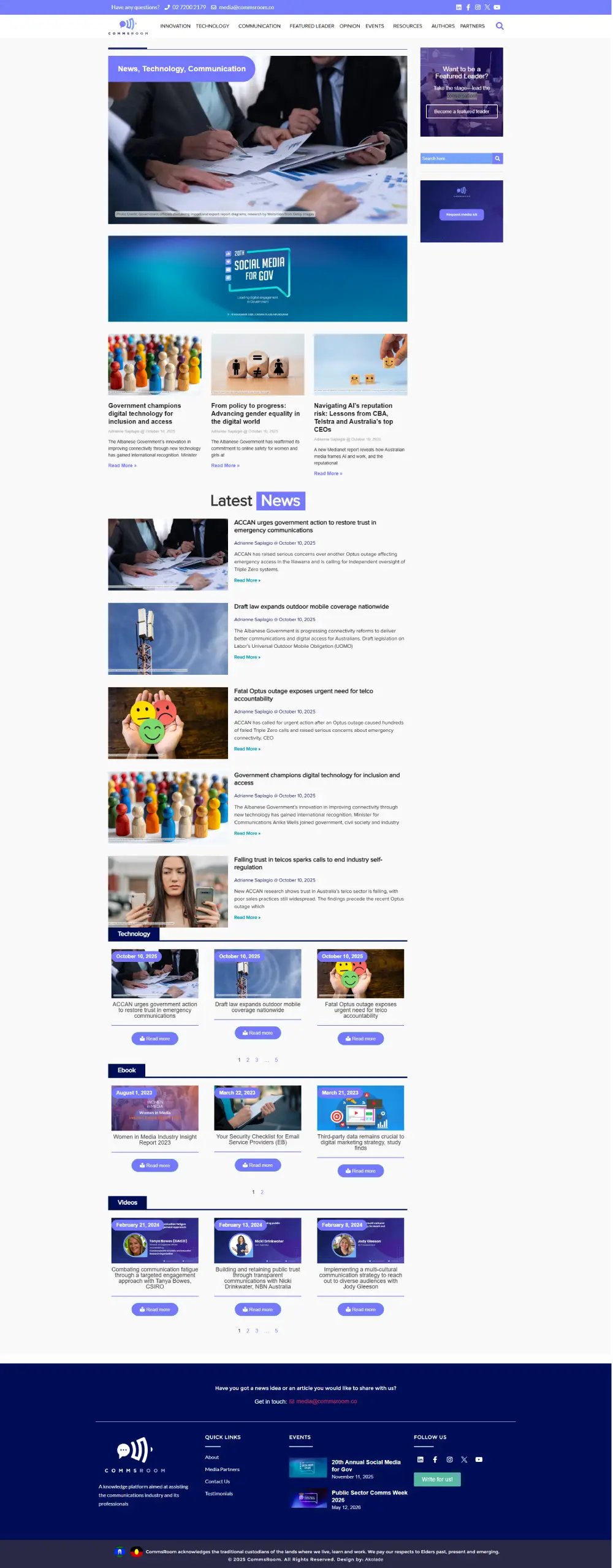
Comms Room, a leading communications newsletter website, wanted a modernized platform with a custom post type (CPT) setup to manage their daily articles and categorized content efficiently.
We developed a fully dynamic, user-friendly website that automates content organization, enhances navigation between topics, and supports high-volume publishing. The result is a sleek, modern platform that streamlines content management while elevating the reader experience — keeping Comms Room’s news delivery fast, engaging, and future-ready.